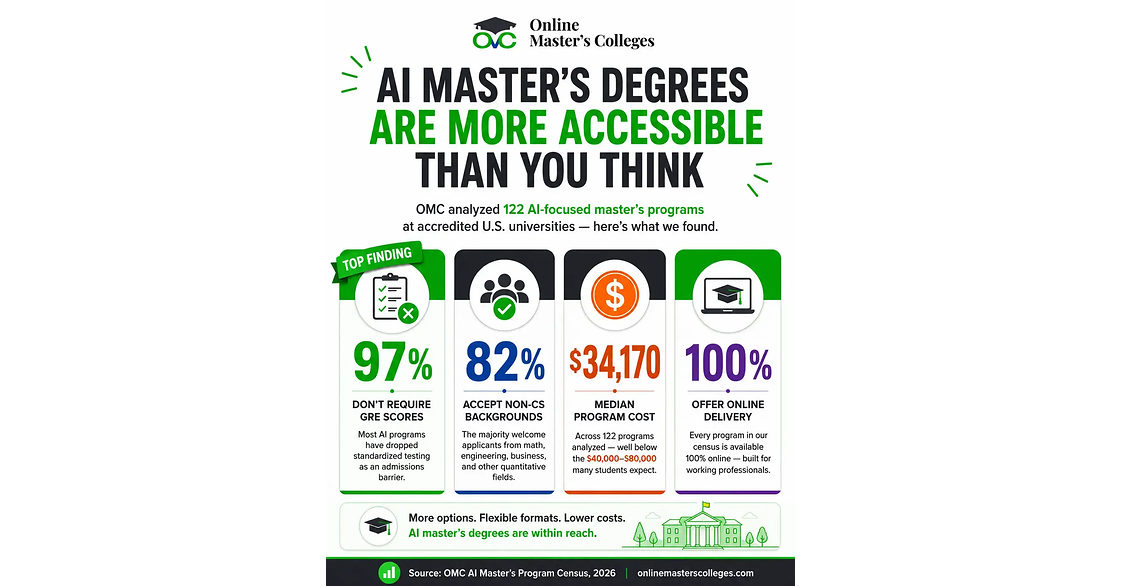
An OnlineMastersColleges.com report finds AI master’s enrollment has risen ~35–40% since 2019 and is growing 10–15x faster than overall graduate enrollment, while the number of AI-focused programs has about doubled over five years. Program accessibility is improving, with 97% of analyzed programs not requiring the GRE and 82% accepting non-CS backgrounds, and graduates are reported to earn substantial salary premiums with positive ROI cited in 2–5 years. The piece frames ongoing employer demand for machine learning, AI research, NLP, and advanced data science as a key driver, though it notes a moderate saturation risk (score B) with an overall market grade of A.
The main market implication is not “AI education is hot,” but that labor demand is still outrunning supply in a way that can sustain premium pricing for credentialed talent. That is bullish for employers that can internalize AI capability cheaply, but it also means the bottleneck is moving from model access to workforce conversion; the next leg of spending likely shifts toward training, certification, and tuition reimbursement rather than pure software licenses. In other words, the economic value chain broadens from cloud/API vendors into education intermediaries and corporate L&D budgets.
For public equities, the cleanest beneficiaries are not traditional universities but platforms with online graduate delivery, adult-enrollment funnels, or employer-sponsored upskilling exposure. The second-order loser is the low-end bootcamp/certificate complex: if a master’s credential remains the clearest wage-premium signal, shorter-form AI programs get commoditized unless they can prove placement or stack into accredited degrees. Watch for universities to use AI programs as margin-accretive seat-fill, which could pressure pricing discipline across adjacent tech graduate programs.
The contrarian risk is saturation arriving faster than the report implies. A 35-40% enrollment jump plus rapidly expanding program count suggests supply is scaling almost as fast as demand; if hiring slows, the salary premium can compress before headline enrollment does. The reversal catalyst is a 1-3 month slowdown in AI headcount plans or tuition reimbursement budgets, while the structural risk over 6-18 months is credential inflation: once too many candidates hold the same degree, the wage spread narrows and ROI claims weaken.
There is probably no immediate single-name trade here, but the setup is useful as a watchlist for online education and adult-skilling names. The market may be overpricing a straight-line growth story and underpricing the eventual commoditization of AI credentials versus demonstrable work experience.
AI-powered research, real-time alerts, and portfolio analytics for institutional investors.
Request DemoOverall Sentiment
moderately positive
Sentiment Score
0.35
