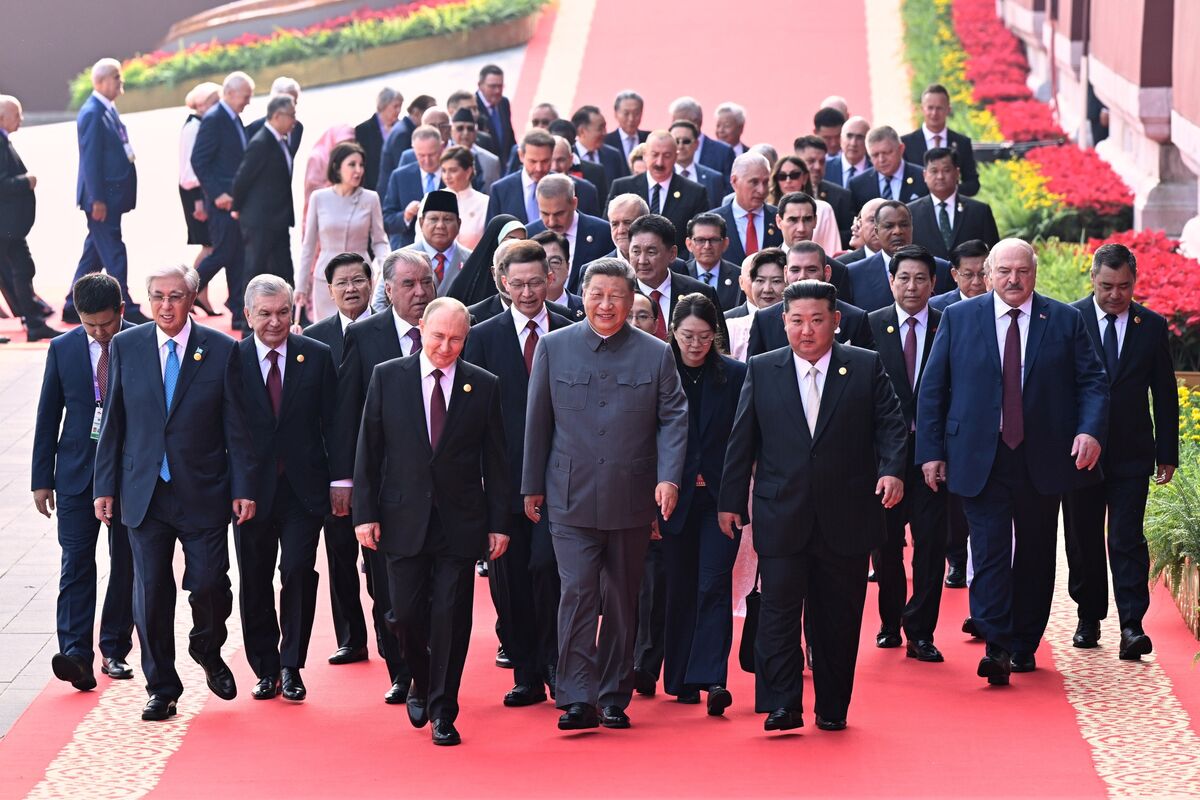
President Xi Jinping's recent military parade featured a notably more authoritarian and condensed guest list compared to 2015, prominently including leaders like Russia's Vladimir Putin and North Korea's Kim Jong Un, alongside new attendees such as Iran and Cuba. This shift underscores a deepening geopolitical alignment and the formation of a more defined bloc coalescing around China, signaling potential implications for global power dynamics and international relations.
The composition of attendees at President Xi Jinping's recent military parade indicates a significant geopolitical realignment compared to the 2015 event. The guest list was notably smaller and skewed more toward authoritarian states, headlined by the presence of Russia's Vladimir Putin and North Korea's Kim Jong Un. The inclusion of a dozen new nations, such as Iran and Cuba, further underscores the formation of a more defined political bloc coalescing around China. While the immediate market impact is assessed as low, this consolidation of non-Western alliances represents a structural shift in global power dynamics. It signals a hardening of geopolitical spheres, which carries long-term implications for international trade, security, and capital flows, even if it is not a direct market-moving event in the short term.
AI-powered research, real-time alerts, and portfolio analytics for institutional investors.
Request DemoOverall Sentiment
neutral
Sentiment Score
0.00
