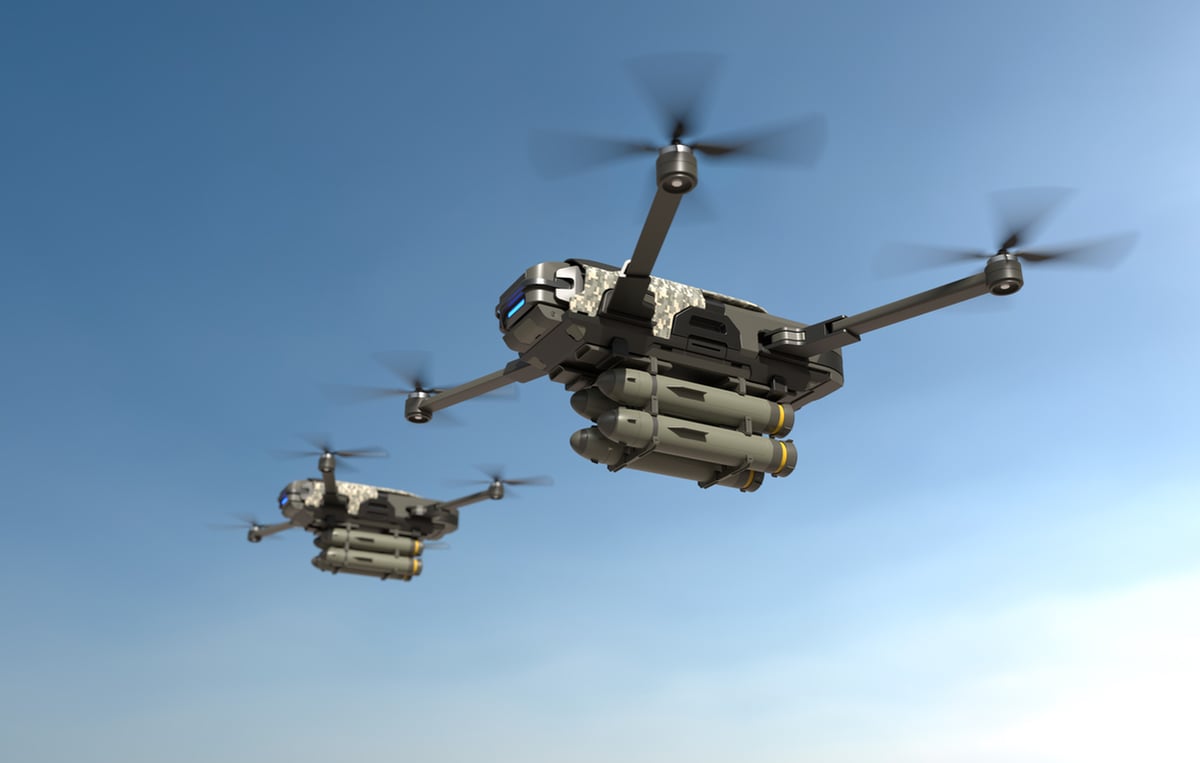
AeroVironment, a prominent drone and autonomous aerial vehicle maker, remains highly volatile but has delivered strong realized returns—shares are trading at $279.46 after falling about 32% from their all-time high and briefly topping $400 in October. Performance metrics show a 1-year gain of 46.6% (vs. S&P 500 +14.2%), a 3-year gain of 203.8% (vs. S&P +70%, total return 76.8%), and a 5-year gain of 222.8% (vs. S&P +88.3%, total return 101.6%); demand was notably boosted after the Feb 2022 Russian invasion of Ukraine, though competition from larger tech and defense firms and recent ETF-related partial sell-offs have increased downside risk.
Market structure: AeroVironment (AVAV) sits between large defense primes (LMT, NOC, BA) and private OEMs; winners are tactical-drone integrators and suppliers of electro-optical payloads and counter-UAS (sensors, comms). Increased entrant activity compresses pricing for commodity airframes but raises premium for field-proven systems and cleared supply chains — expect AVAV to retain pricing power on USG-certified platforms and services over 12–36 months. Cross-asset: equity volatility in AVAV will stay elevated (IV +20–40% vs. peers near events), modest positive credit impulse for mid‑small cap defense names, limited FX/commodity impact beyond specialty metals and RF semis supply chains.
Risk assessment: Tail risks include a sudden US export restriction/ITAR tightening or a major counter-UAS breakthrough that makes current platforms obsolete — both could cut revenues >30% in 12–24 months. Short-term (days–weeks) downside driven by ETF flows (e.g., ARK) and options gamma; medium-term (3–12 months) sensitivity to US/European defense budgets and contract timing; long-term (2–5 years) risk is commoditization as Tier‑1 primes internalize drone capabilities. Hidden dependencies: single large program awards, COTS component shortages, and classified contracts that create lumpy revenue recognition.
Trade implications: Tactical trade — establish a 2–3% long AVAV position over 4–12 months, scaling in at 20% and 35% drawdowns (e.g., add at ~$220 and ~$180), target +40–60% upside on contract wins; hedge with a 6–9 month 25–40% OTM bear-put spread if risk-averse. Pair trade — long AVAV vs. short XAR (SPDR S&P Aerospace & Defense) to express small-cap drone outperformance; size 1.5:1 to limit macro beta. Options — buy 3–6 month call spreads 25–35% OTM to play re-rating after order announcements; sell 60–90 day 12–18% OTM puts for premium if willing to accumulate at a ~15% discount.
Contrarian angles: Consensus fears competition and Ark-led selling; that may be overstated — certification, field support, and USG logistics create structural moat that slows commoditization, implying sell-offs tied to flows not fundamentals. Historical parallel: early 2010s missile/ISR cycles where small-cap specialists re‑rated after multi-year procurement troughs; AVAV could re-rate on 1–2 large (> $50m) awards. Unintended consequence: too-large short positions could face squeezes on concentrated contract news; use size limits and clear stop-loss thresholds.
AI-powered research, real-time alerts, and portfolio analytics for institutional investors.
Request DemoOverall Sentiment
mildly positive
Sentiment Score
0.28
Ticker Sentiment
