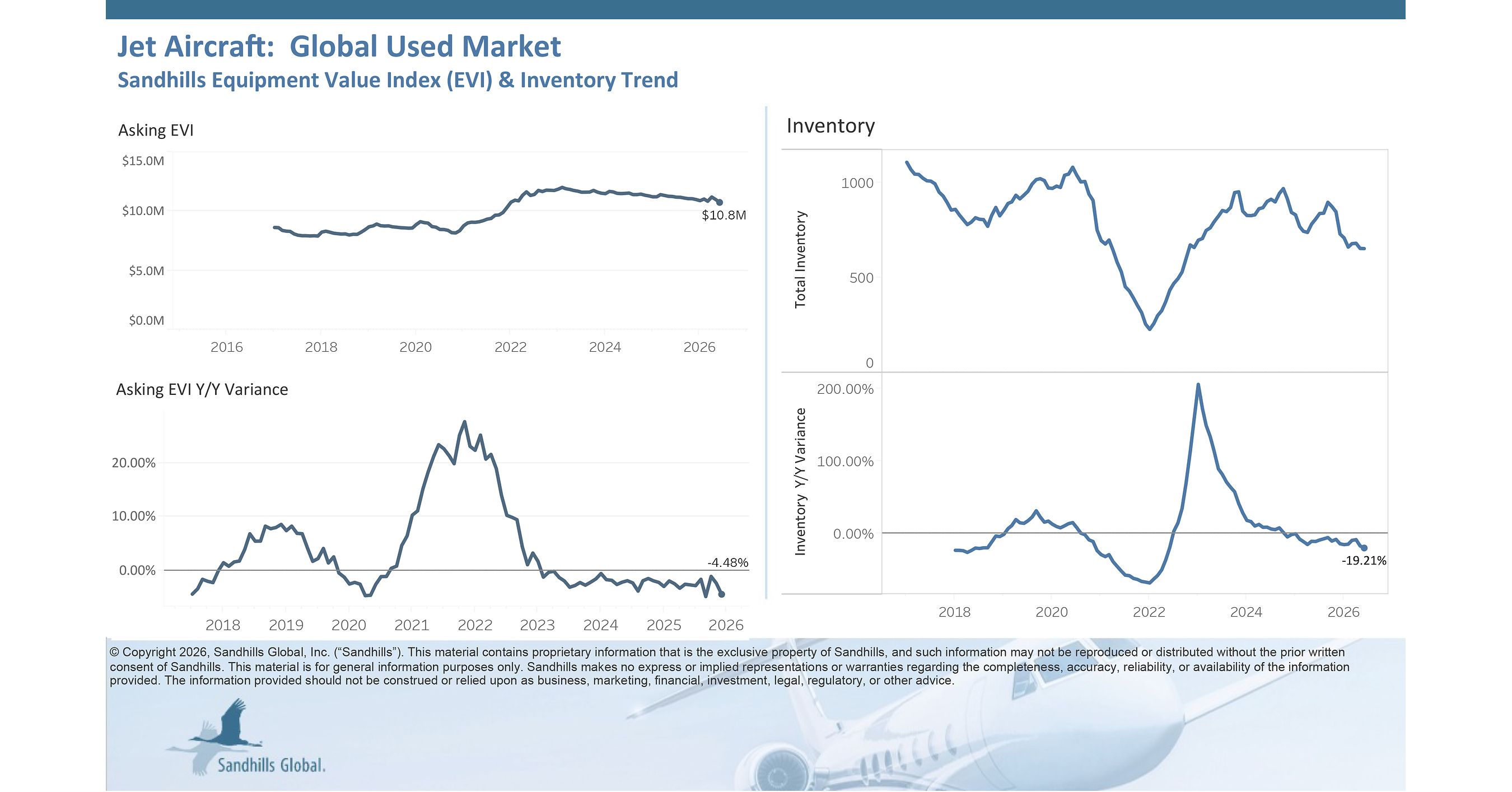
Sandhills reports aircraft inventory remains tight, with global used jet inventory down 19.21% YoY (down 0.15% MoM) in June and used jet asking prices falling 4.48% YoY (down 2.28% MoM). Used turboprop inventory declined for seven straight months, down 13.67% YoY and 5.15% MoM, though turboprop asking prices rose 3.12% MoM and 3.32% YoY. U.S./Canada single-engine piston inventory rose 2.48% MoM but fell 14.08% YoY, with asking values down 0.61% MoM and 0.74% YoY.
This reads more like a residual-value and utilization signal than a clean demand boom. The important nuance is that tight inventory is not translating into universally firmer pricing, which usually means financing frictions and seller discipline are still suppressing transaction velocity. That is constructive for owners with low leverage, but it is a headwind for forced sellers, remarketers, and any platform whose monetization depends on turnover rather than just quotes.
The clearest second-order winner is the aftermarket chain: when aircraft stay in service longer because replacement supply is tight, parts, maintenance, avionics upgrades, and refurbishment spend rise. That favors high-margin aerospace service names like TDG more than pure OEMs, while also supporting niche exposure such as TXT’s turboprop/helicopter franchise. The loser is the high-end pre-owned market where bid-ask spreads can stay wide until financing costs ease; that can pressure residual assumptions for lessors and suppress new-unit pricing power in some business-aviation segments.
Contrarian take: the market may be over-reading "tight inventory" as bullish for the whole complex. In jets, falling asking values alongside lower inventory is a classic sign of a stale market clearing slowly, not healthy acceleration. A 1-3 month catalyst would be lower rates or a restart in corporate flight hours; a 6-18 month downside case is recessionary credit widening that forces liquidation and overwhelms scarcity. If used jet pricing keeps falling on the next two monthly prints, the bullish residual-value thesis is wrong.
AI-powered research, real-time alerts, and portfolio analytics for institutional investors.
Overall Sentiment
mildly negative
Sentiment Score
-0.25
