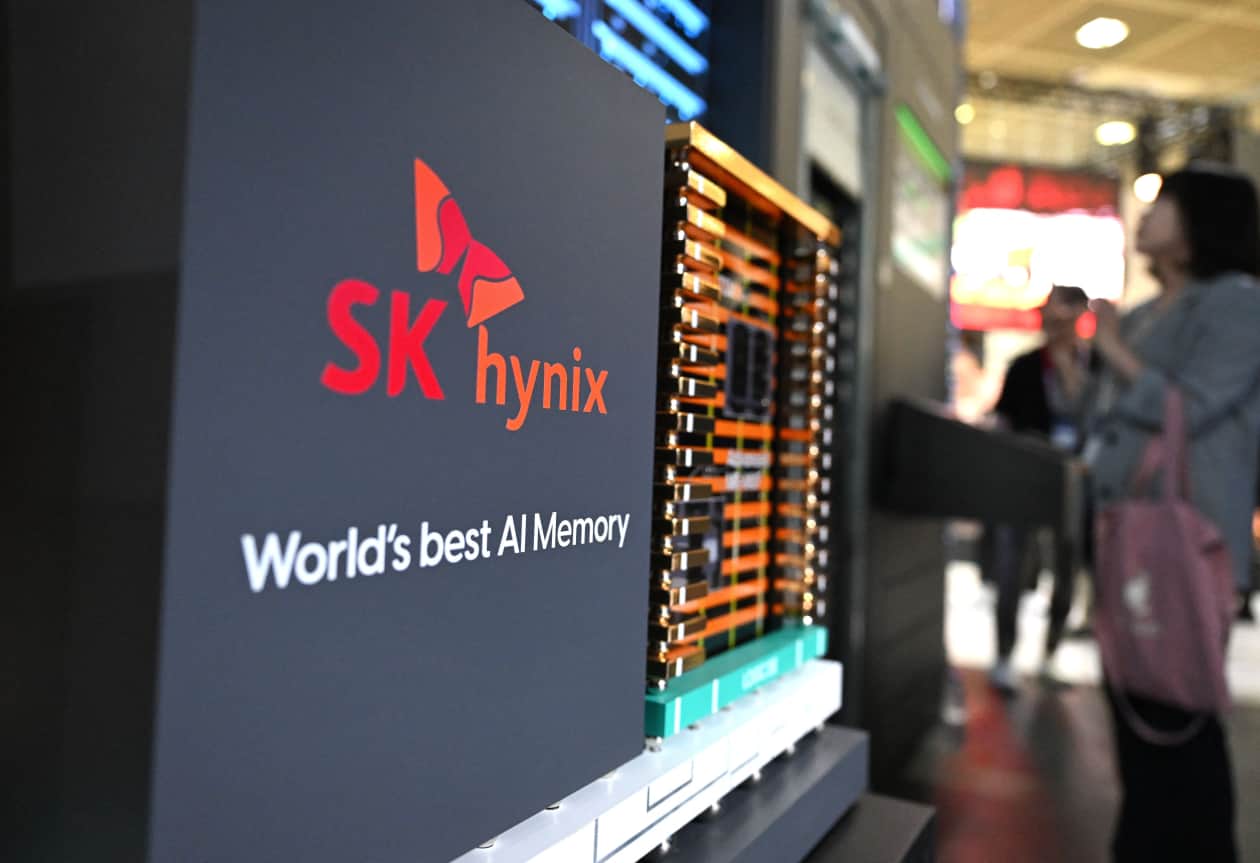
SK Hynix is seeking to raise nearly $30 billion in a U.S. listing on Nasdaq, which could broaden access for U.S. investors and support a higher valuation multiple. The move is being viewed as a potential positive for SK Hynix, though it may also create more competition and awareness around memory industry dynamics for Micron. The article is largely analytical rather than event-driven, so near-term market impact appears modest.
The biggest second-order effect is not simply that SK Hynix becomes investable in the U.S., but that it widens the universe of public ways to express the memory cycle. That tends to compress MU’s scarcity premium: when investors can rotate between a U.S.-listed pure-play memory name and the incumbent, MU becomes more of a relative value asset than a standalone narrative. In the near term, that can cap multiple expansion even if fundamentals remain constructive, because incremental capital no longer has to crowd into one proxy.
For MU, the risk is that the listing arrives just as the market starts to map out the next leg of the cycle. If investors conclude SK Hynix deserves a higher U.S. multiple, they may implicitly re-rate the entire group, but the more likely first-order flow is dispersion: better liquidity and broader ownership for SK Hynix, with MU losing some attention share. That matters because memory names often trade on perception of regime change before the earnings inflect, so the listing could become a sentiment headwind for MU over the next 1-3 months even without a change in demand.
The potential beneficiary beyond the obvious is NDAQ. A marquee cross-border listing supports the exchange’s branding around global liquidity access and may improve the odds of follow-on international issuers choosing Nasdaq, particularly in technology and semiconductors. The caveat is that one large listing does not meaningfully move the earnings base, so any upside for NDAQ is more about signaling and pipeline optionality than near-term fee leverage.
The contrarian view is that the market may be overestimating how much a U.S. listing changes economics for a mature industrial company. If the underlying memory cycle softens, a higher U.S. ownership base can actually accelerate volatility by making the name more ETF- and momentum-sensitive. In that case, the listing becomes a flow event that raises tactical trading activity without changing the medium-term earnings trajectory.
AI-powered research, real-time alerts, and portfolio analytics for institutional investors.
Request DemoOverall Sentiment
mildly positive
Sentiment Score
0.15
Ticker Sentiment
