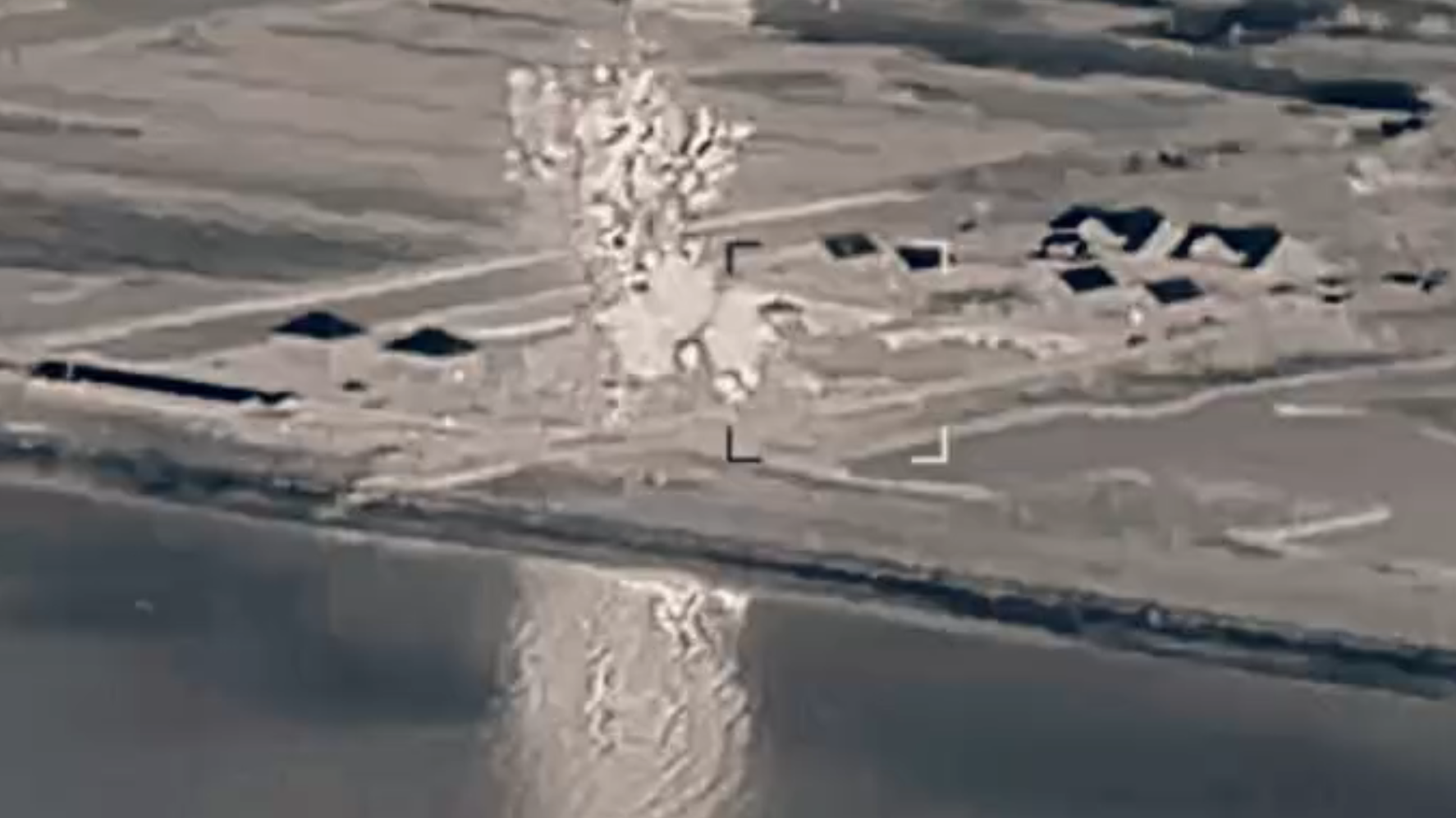
Ukraine’s SBU Alpha unit struck an FSB headquarters in occupied Kherson Oblast, killing and wounding about 100 Russian troops, according to President Zelensky. The attack also destroyed a Pantsir-S1 air defense system valued at up to $20 million, underscoring continued escalation in the war and sustained pressure on Russian military infrastructure. The news is geopolitically significant and could incrementally support defense-related assets, but it is unlikely to trigger broad market-wide repricing.
This is a tactical escalation in the war’s attrition phase, but the market implication is less about the headline casualty count and more about the growing survivability gap between fixed Russian command infrastructure and low-cost precision attack. When a secure command node and an air-defense asset can be degraded inside occupied territory, the effective cost curve is asymmetric: Ukraine forces Russia to spend materially more on dispersion, hardening, and air defense coverage than the attacker spends to generate the strike. That tends to widen the discount the market assigns to any near-term de-escalation thesis and keeps sanctions/geopolitical risk premium embedded in European risk assets.
The second-order effect is on Russian logistics and force coordination in the southern theater. Even if front-line operations do not change immediately, repeated hits on command-and-control nodes typically slow response times, reduce local initiative, and force command rerouting deeper away from the front, which lowers operational efficiency over weeks to months. The more relevant investment angle is not energy supply disruption from this one event, but the probability distribution shift toward a longer war, higher replenishment spending, and continued pressure on NATO procurement cycles, especially air defense, counter-UAS, EW, and munitions.
The contrarian point is that market complacency may still be too high around how quickly these strikes can accumulate into a logistics problem for Russia. However, the near-term path is still noisy: unless attacks begin hitting export infrastructure or trigger a broader escalation response, the shock is more likely to support defense sentiment than produce a broad risk-off unwind. Watch for retaliation against Ukrainian civilian or energy infrastructure over the next 1-3 weeks; that is the catalyst that would most clearly reprice energy, European utilities, and defense names.
Long-duration beneficiaries remain the defense supply chain rather than headline primes alone: the bottleneck is in interceptors, sensors, and integrated air defense, not just platforms. If Ukraine keeps forcing Russia to spend scarce modern air-defense assets on rear-area protection, NATO members will likely accelerate replenishment orders and inventory rebuilds into 2025-2026, creating a multi-quarter demand tail for select contractors.
AI-powered research, real-time alerts, and portfolio analytics for institutional investors.
Request DemoOverall Sentiment
strongly negative
Sentiment Score
-0.70
