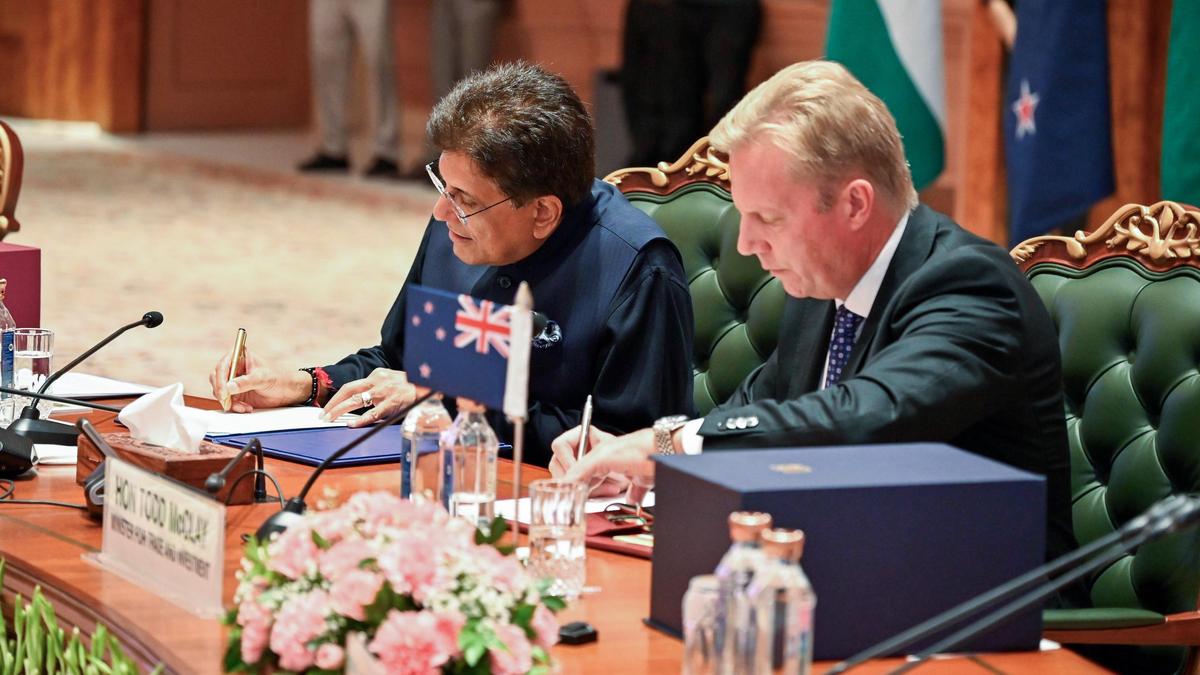
India and New Zealand signed a historic Free Trade Agreement on April 27, 2026, with New Zealand eliminating tariffs on 100% of goods imported from India and India removing or reducing tariffs on 95% of current imports from New Zealand. The deal is aimed at deepening trade, investment, and people-to-people ties and should improve bilateral market access for exporters in both countries. The agreement is a meaningful policy catalyst for trade-sensitive sectors, though its immediate market impact is likely concentrated rather than broad-based.
This is less a single-country tariff headline than a marginal re-routing of supply chains toward politically “clean” jurisdictions. The immediate winners are Indian exporters with tariff-sensitive, labor-intensive exposure where New Zealand’s market is too small to matter on volume but useful as a signaling device for broader OECD market access; the second-order benefit is reputational, lowering friction for future bilateral or bloc-level negotiations with Australia, the UK, and the EU. For New Zealand, the asymmetry is stronger on the import side: lower input costs can compress inflation with a lag, giving the central bank more room to ease if domestic demand softens.
The less obvious loser is any third-country supplier currently competing with India into New Zealand on price rather than brand or logistics. If India uses this as a template, watch for category-specific share gains in processed foods, pharmaceuticals, textiles, and light engineering goods where tariff removal can offset freight disadvantage. In New Zealand, exporters in dairy, meat, and horticulture may see only incremental upside because India’s partial tariff reductions still leave meaningful non-tariff barriers; that makes the near-term trade balance effect much smaller than the headline suggests.
The key risk is execution and timing: FTAs often take months to years to translate into actual customs changes, rules-of-origin compliance, and commercial contracting. Consensus is probably overestimating the speed of volume impact and underestimating the inflation/FX channel in New Zealand, where cheaper imported goods can tighten imported disinflation and support rate cuts sooner than expected. Conversely, if implementation stalls or exclusions proliferate, the “historic” narrative fades quickly and the trade repricing reverses.
Contrarian view: the deal may be more valuable as a diplomatic wedge than as an immediate earnings event. The market should focus less on bilateral trade totals and more on whether this improves India’s negotiating leverage in future agreements, which could matter far more for medium-term manufacturing competitiveness than the direct New Zealand exposure itself.
AI-powered research, real-time alerts, and portfolio analytics for institutional investors.
Request DemoOverall Sentiment
strongly positive
Sentiment Score
0.72
