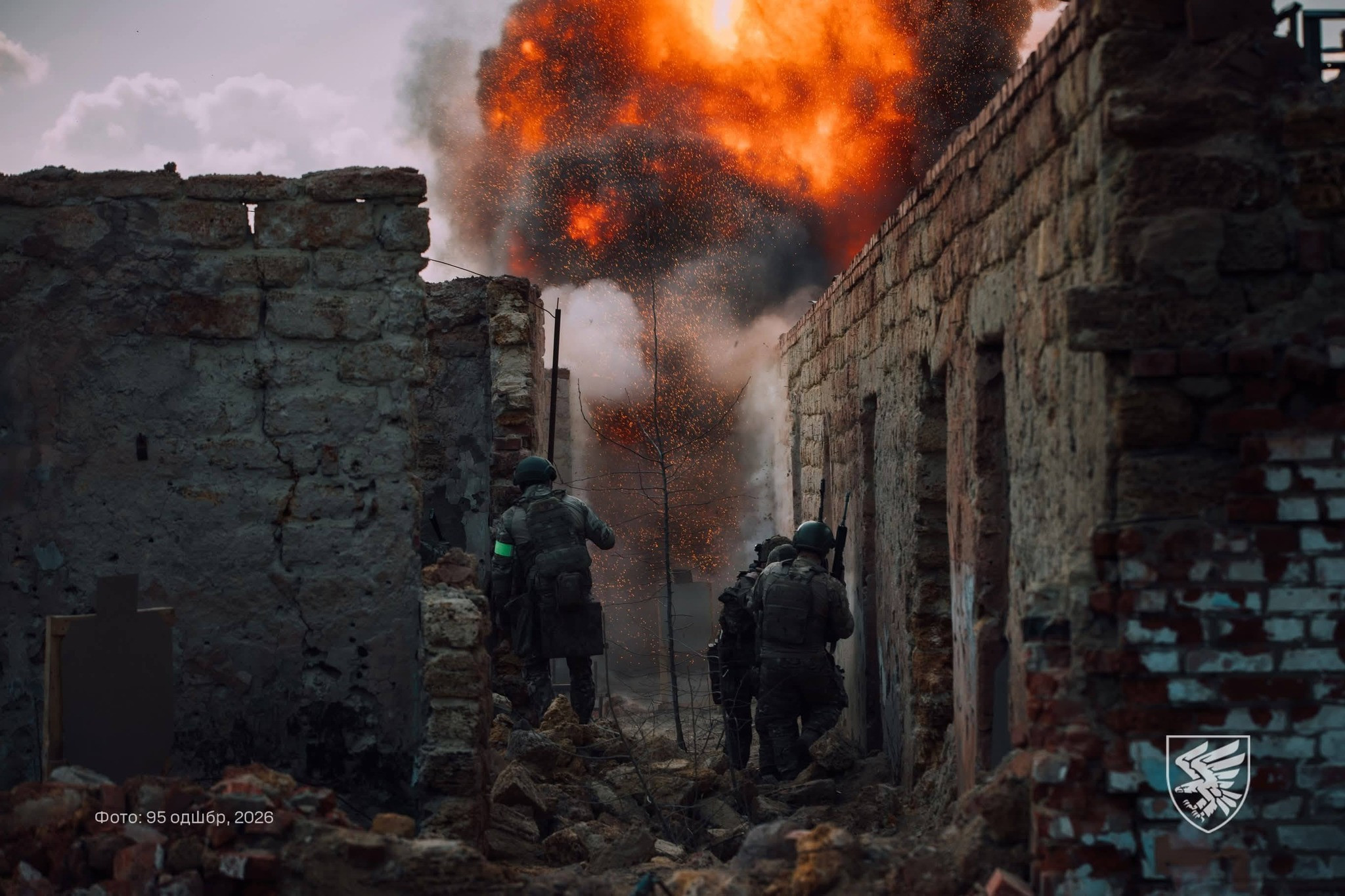
Russia is facing mounting battlefield setbacks, with April marking a net territorial loss of about 113 square kilometers and estimates of roughly 35,000 troop losses per month. Ukraine’s drone campaign is increasingly effective, with FPV systems reportedly driving up to 80% of casualties and deep strikes pressuring Russian logistics, oil facilities, and air defenses. Zelensky said strikes have already cost Moscow $7 billion in lost oil revenues this year, suggesting a growing strategic and economic burden on Russia.
The market implication is less about a binary “Ukraine wins” headline and more about a widening asymmetry in adaptation speed. The side that can better close the loop between sensing, targeting, and disrupting logistics is now advantaged, which favors firms and countries with scalable drone manufacturing, EW, and ISR ecosystems over legacy mass-armor doctrines. That creates a second-order negative for heavy industrial and traditional defense platforms tied to attritional warfare assumptions, while boosting low-cost autonomous systems, components, and software layers.
Energy is the cleanest macro transmission. Sustained disruption of Russian refining and export infrastructure raises the probability of a persistent diesel/petchem tightness spike even if crude itself stays range-bound, because Europe’s marginal replacement barrels increasingly need longer voyages and higher conversion costs. The key is duration: if these strikes keep forcing intermittent outages for 1-3 months, the price signal should show up first in product cracks and tanker demand, then in broader inflation expectations. If Russia can harden air defenses or disperse operations, the move likely fades into a volatility event rather than a structural supply shock.
For equities, the underappreciated loser is any asset whose thesis depends on cheap Russian molecules or on uninterrupted Eurasian logistics. Russian-export-exposed refiners, fertilizer producers, and European industrials with high gas sensitivity face a higher probability of margin whipsaw, but the more interesting trade is on enablers: drone suppliers, counter-UAS, and battlefield software contractors should see budget persistence even if the war de-escalates, because both sides will preserve the capability set. The contrarian risk is that markets may already be overpricing a decisive turning point; Russia’s sheer depth means the more likely medium-term path is not collapse but a noisier, more expensive stalemate with elevated strike intensity.
AI-powered research, real-time alerts, and portfolio analytics for institutional investors.
Request DemoOverall Sentiment
mixed
Sentiment Score
0.15
