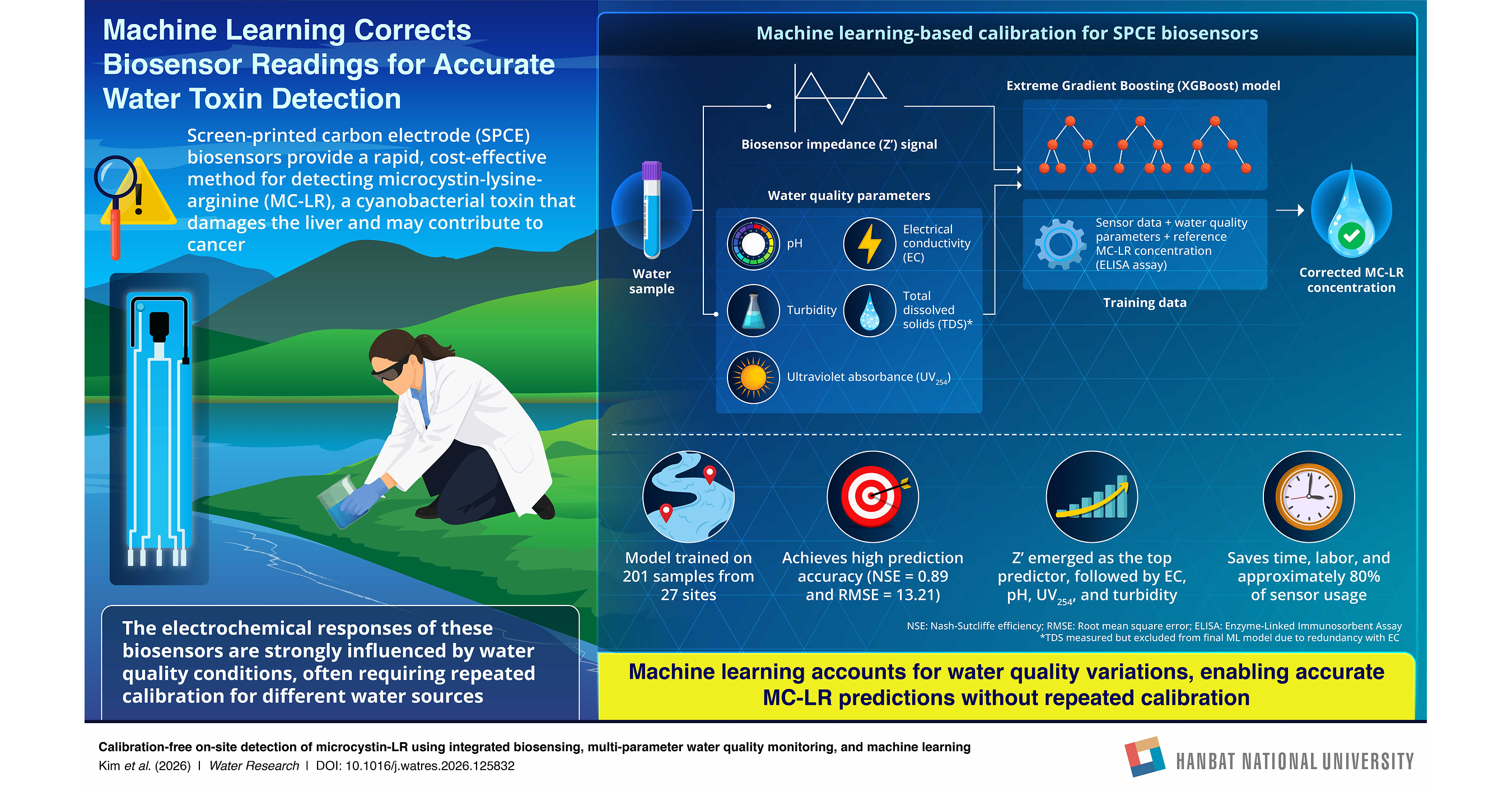
Researchers developed a calibration-free machine learning framework for portable screen-printed carbon electrode (SPCE) biosensors to measure microcystin-LR (MC-LR) in variable freshwater conditions. The best model (XGBoost) achieved Nash–Sutcliffe efficiency of 0.89 and RMSE of 13.21, enabling accurate on-site toxin readings without repeated sample-specific recalibration by using water quality inputs (e.g., pH, turbidity, electrical conductivity, UV254). The work suggests lower sensor usage and costs while improving speed and accuracy for monitoring harmful algal blooms.
The immediate market read is not a product-cycle winner but a marginally bullish signal for the broader environmental diagnostics stack. If calibration can be generalized, the economic value shifts away from labor-heavy lab workflows toward low-cost field deployment, which favors platforms that sell both instruments and recurring consumables/data services. The second-order effect is that cheaper monitoring can increase test frequency, so the first-order margin loss at traditional labs may be offset by higher volume in consumables for sensor OEMs and water analytics providers.
The biggest near-term losers are not obvious headline names but the manual calibration layer: third-party environmental testing labs, field-service integrators, and workflow software that monetizes bespoke tuning. Over 6-18 months, the larger beneficiaries could be water infrastructure vendors with installed municipal relationships, because procurement buyers care less about the underlying ML and more about validated compliance workflows. Think of this as an adoption-enabler rather than a standalone moat; the value capture depends on who owns the validation, device distribution, and regulatory sign-off.
The main risk is model drift and transferability: a system trained on a limited regional dataset can fail when water chemistry shifts, bloom composition changes, or sensor hardware changes. That creates a months-long catalyst path at best, not a days-long trade, and it means any upside is contingent on external validation from utilities or regulators rather than academic publication cadence. If we do not see procurement pilots, EPA/state acceptance, or OEM integration within 1-3 quarters, the tradeable implication fades quickly.
Contrarian view: the consensus may be overstating near-term commercialization. This reduces one bottleneck in microcystin testing, but it does not solve sample collection, chain-of-custody, or liability for false negatives, which are the real adoption blockers in drinking-water monitoring. The more interesting long-run implication is for broader biosensor markets: once calibration becomes software-defined, OEMs can push lower ASP hardware and monetize through subscriptions, which is structurally positive for platform vendors but not necessarily for hardware-only names.
AI-powered research, real-time alerts, and portfolio analytics for institutional investors.
Request DemoOverall Sentiment
mildly positive
Sentiment Score
0.25
