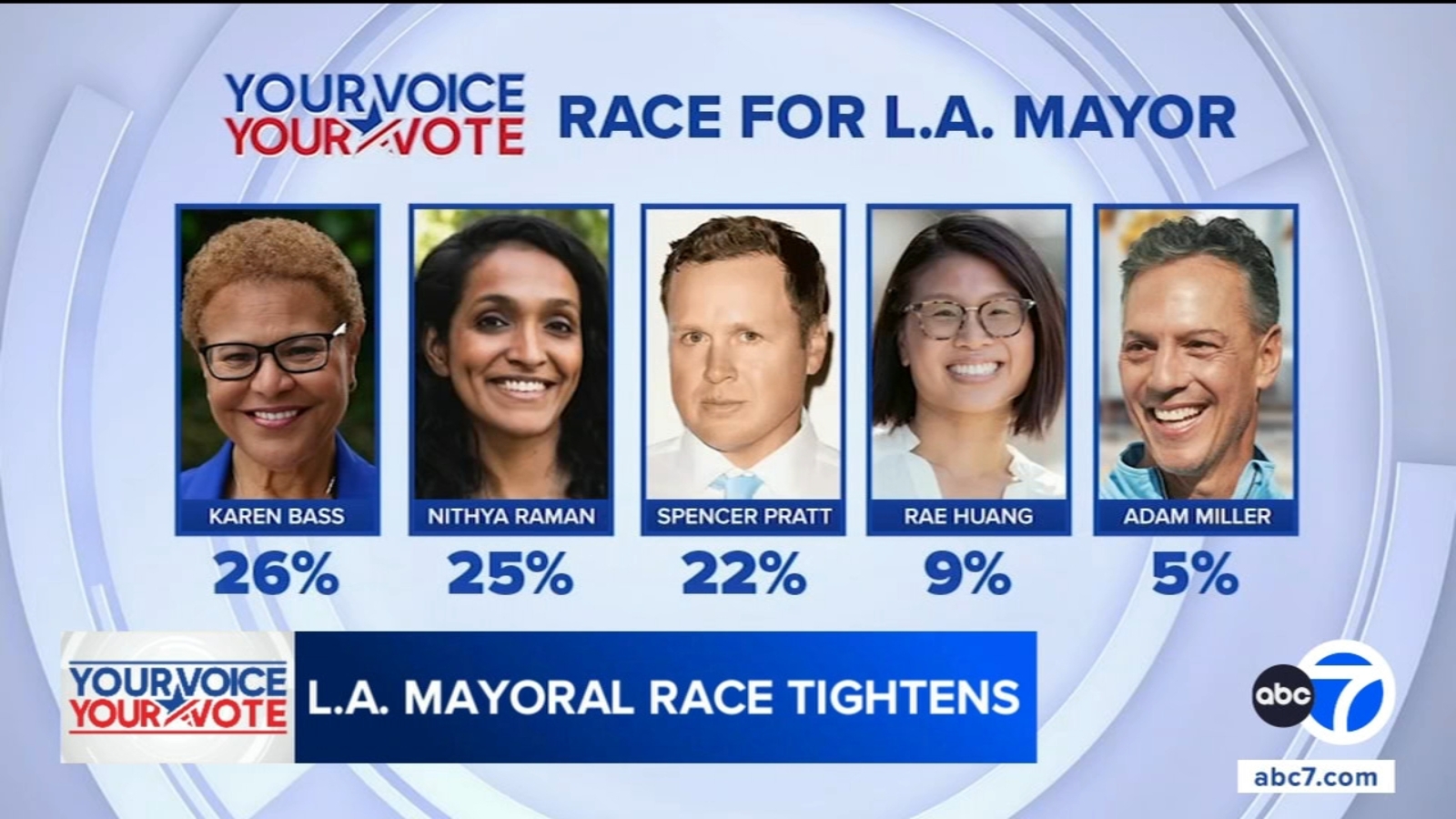
A new UC Berkeley-L.A. Times poll shows the Los Angeles mayoral race tightening, with Karen Bass at 26%, Nithya Raman at 25%, and Spencer Pratt at 22%, all within the poll's 3% margin of error. Ten percent of voters remain undecided, while the California governor's race shows Xavier Becerra leading Steve Hilton 23% to 20%. The article is political polling coverage with no direct financial market catalyst.
A tightening mayoral race matters less for direct market exposure than for what it signals about municipal policy volatility in a high-beta urban economy. A split vote among multiple left-leaning candidates increases the probability of a more activist housing, labor, and public-safety agenda, which would be negative for office landlords, multifamily operators, and any business model dependent on downtown foot traffic or permitting speed. The second-order effect is that even a small shift in perceived governance quality can widen the discount rate investors apply to LA-exposed real estate and local-service cash flows over the next 6-18 months.
The more investable implication is not the headline lead itself, but the fragmentation of the vote. If the field stays this compressed into the final days, tactical money tends to favor defensive positioning around sectors tied to city execution risk: transit-adjacent retail, hospitality, and lower-tier office could see renewed underperformance if voters conclude the race is unpredictable and policy direction will be unstable. Conversely, any candidate seen as more pragmatic on housing supply or public safety would be a marginal positive for entitlement-sensitive developers and Class A downtown assets, because the market would price a lower probability of delayed approvals and tenant flight.
For the governor’s race, the near-term market impact is mostly through expectations for California’s regulatory tempo rather than immediate fiscal policy. A narrower-than-expected statewide margin increases the odds of a more transactional post-election environment, where both parties lean into targeted concessions on energy, labor, and housing—supportive for incumbents in regulated sectors but a headwind for pure policy-discretion names. Over the next few weeks, the key catalyst is not polling alone but whether undecided voters break late; that can flip the implied policy path faster than a typical local election because investors are already underpricing California political risk.
The contrarian view is that the market may be overestimating the incremental asset-price impact of one municipal race. Los Angeles policy is often constrained by state law, budget math, and legal challenge, so even a sharp political shift may not translate into immediate earnings changes. That means the better trade is likely a relative-value expression on LA-exposed assets versus broader California or national peers, not a directional macro bet on election outcomes.
AI-powered research, real-time alerts, and portfolio analytics for institutional investors.
Request TrialOverall Sentiment
neutral
Sentiment Score
0.00
