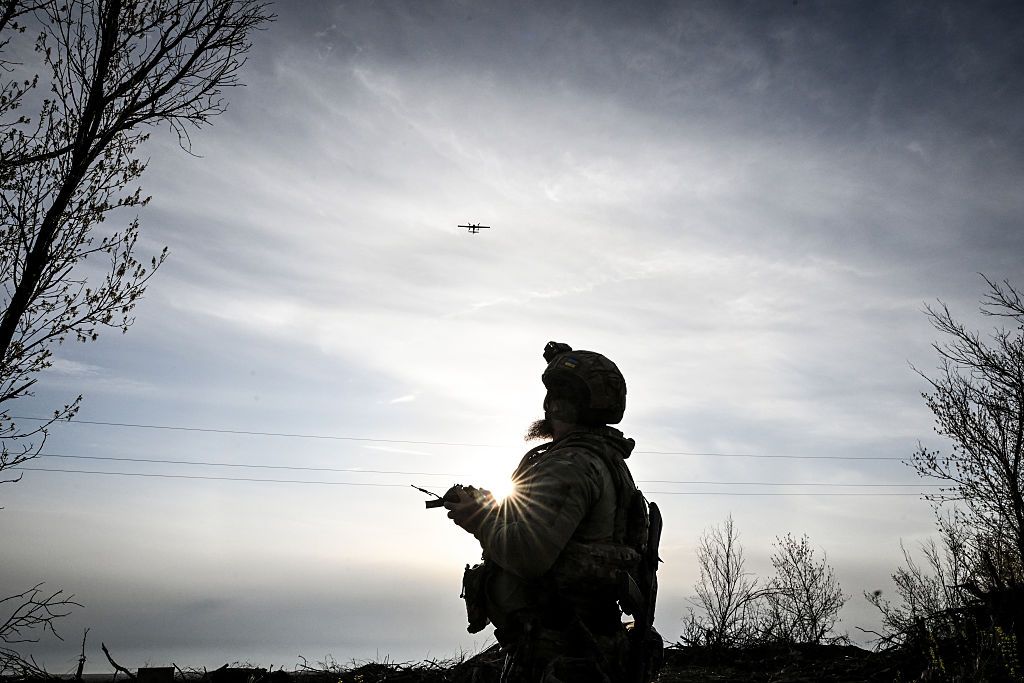
Ukraine says it has become the first country to scale remotely operated interceptor drones for long-distance strikes, with more than 10 defense manufacturers now integrating the capability. Defense Minister Mykhailo Fedorov said the systems can be controlled from protected locations in cities like Kyiv and Lviv, improving interception effectiveness while reducing operator risk. The development, built under the Brave1 defense-tech platform, signals rapid battlefield innovation and could support Ukraine's air-defense capabilities.
This is less a drone story than a command-and-control story: the marginal advantage is moving from airframe count to latency, operator survivability, and software-defined integration. If remote interception really scales, the beneficiaries are the firms that own secure datalinks, autonomy stacks, EO/IR payload integration, and ruggedized compute — not just the drone OEMs themselves. The second-order effect is that the value chain shifts toward distributed manufacturing and away from single-point front-line deployment, which should compress procurement cycles and favor modular, rapidly upgradable systems.
The clearest winner is Ukraine’s domestic defense-tech ecosystem, because the battlefield becomes an active proving ground with fast feedback loops and exportable IP. That creates a likely flywheel: better kill-chain performance drives more funding, which improves component sourcing, which improves reliability and scale. The underappreciated loser is any legacy air-defense supplier whose moat depends on centralized crews, expensive launch infrastructure, or slower software refresh cadence; their systems look increasingly capital-inefficient versus cheap, networked interceptors.
The near-term risk is operational rather than technological: EW adaptation, link jamming, spoofing, and targeting of control nodes can degrade effectiveness quickly if the communications layer is not hardened. In a 1-3 month window, headlines may overstate the capability before adversaries force a reset in assumptions. Over 6-18 months, the bigger catalyst is whether this model exports to NATO procurement, because that would re-rate the entire counter-UAS and tactical autonomy basket.
Consensus is probably underestimating how much this accelerates demand for non-kinetic enablers: spectrum management, encrypted mesh networking, edge AI, and resilient satellite backhaul. The market often prices drones as a hardware theme, but the durable margin pool is moving into software, comms, and test/validation infrastructure. If adoption persists, the bottleneck becomes production-quality secure networking, not propulsion or frames.
AI-powered research, real-time alerts, and portfolio analytics for institutional investors.
Request DemoOverall Sentiment
mildly positive
Sentiment Score
0.35
