
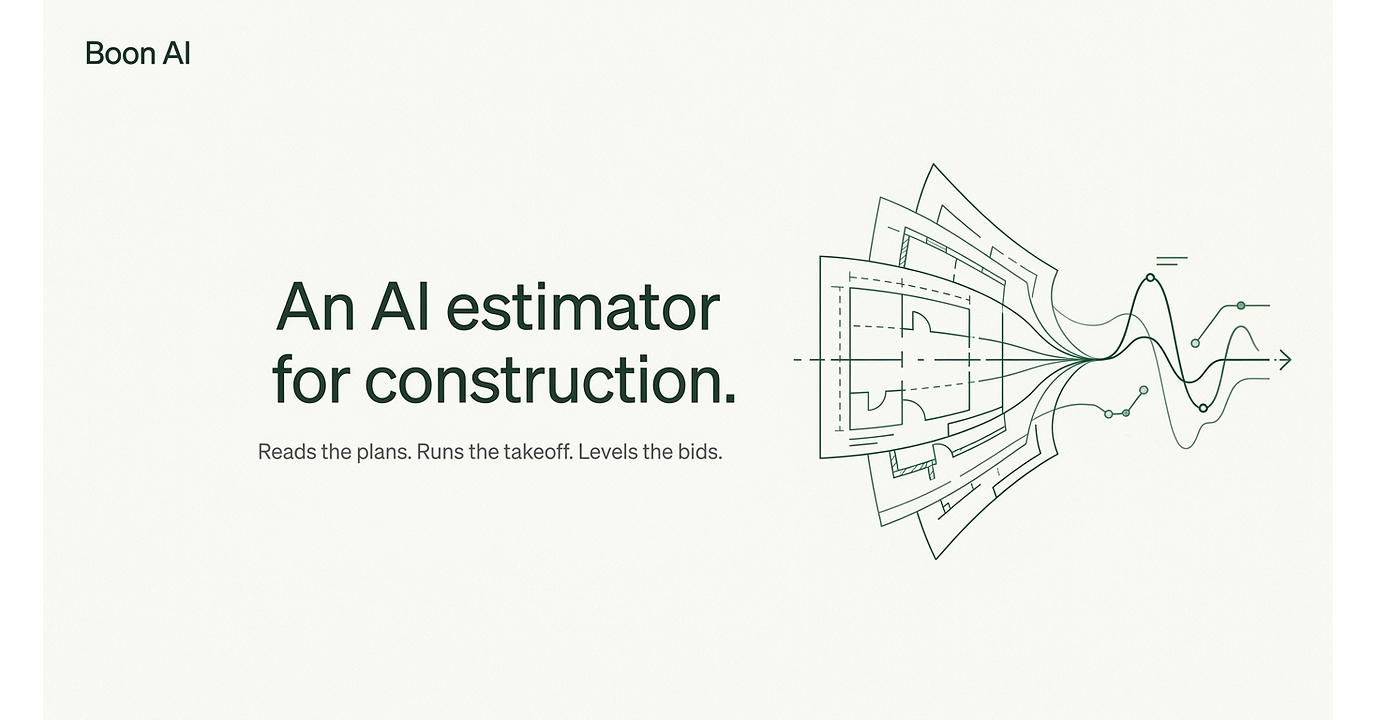
Boon AI launched early access to Boon Agent, an AI construction estimator that compresses an end-to-end bid workflow from roughly three weeks to about seven minutes in a real project. The agent triages bids, performs quantity takeoff across trades, generates trade RFQs, and levels sub bids while flagging drawing/spec conflicts with page references and an audit trail. The release positions the product as an “estimator, not a faster tool,” aimed at subcontractors and general contractors for preconstruction automation.
The market implication is not that construction gets automated overnight; it is that bid capacity becomes less constrained by headcount. That is bullish for the most process-heavy contractors and specialty subs because they can pursue more work with the same precon team, but it also lowers the barrier to entry for smaller competitors, which can increase bid intensity and eventually compress margins. In other words, productivity gains may show up first as higher win rates and faster backlog conversion, then partially leak away through tougher pricing.
For public-market read-through, the more interesting exposure is not a pure-play AI vendor but construction software and contractor equities. Incumbent workflow platforms such as PCOR, TRMB, and ADSK are not immediately threatened on revenue, but they face a longer-dated risk that AI agents commoditize point solutions and shift buyer willingness from seat-based pricing to outcome-based pricing. Contractors with large preconstruction footprints like EME, FLR, and MTZ are the nearer-term beneficiaries if this kind of tooling actually scales in production, because their bid throughput and response time can improve without adding overhead.
The catalyst path is slow: pilots and press releases are days, real budget reallocation is quarters, and meaningful platform displacement is 6-18 months. The key falsifier is whether early access converts into measurable usage, lower bid-cycle labor, or better win rates; without that, the story stays at demo-quality. A second-order risk is that faster estimating increases competitive bidding across the industry, which could make this a net negative for margins even if software adoption is positive.
The contrarian view is that consensus will overrate estimator replacement and understate estimator augmentation. If the tool mainly helps top contractors bid more jobs, the structural winner may be the best operators, not the software layer, and the biggest loser could be the long tail of smaller firms that relied on scarce estimating labor as a moat.
AI-powered research, real-time alerts, and portfolio analytics for institutional investors.
Request TrialOverall Sentiment
mildly positive
Sentiment Score
0.25
Ticker Sentiment
