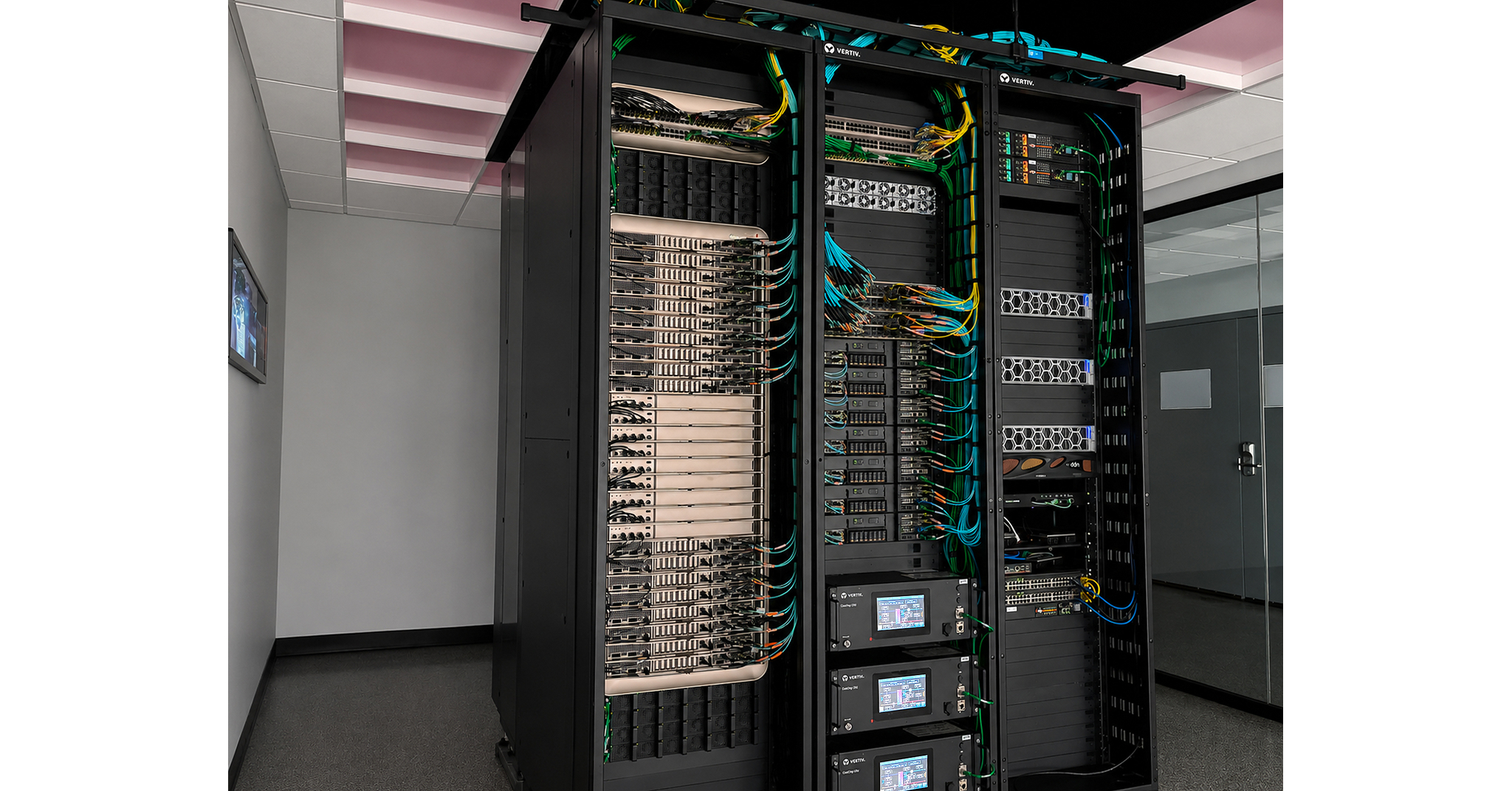
Vertiv (VRT) announced deployment of integrated power, liquid cooling, rack infrastructure, and installation services for the Naval Postgraduate School’s NVIDIA DGX GB300 system. The three-rack Vertiv SmartIT configuration is designed to modernize an existing facility to meet high-density AI power/thermal and commissioning needs for education and research. The news is operationally positive for Vertiv’s AI infrastructure positioning, but it is not quantified in financial terms.
This is less about the specific deployment and more about validation that AI spend is moving up the stack into power, thermal, and commissioning. That favors VRT because the economic prize is not one rack sale; it is a higher attach rate per megawatt, more services revenue, and better mix as customers buy integration rather than components. The competitive danger is that this also lowers the barrier for ETN and Schneider Electric to sell a comparable “single-vendor” solution, so the moat depends on execution speed and installed-base pull-through, not just product breadth.
Near term, the market should treat this as a sentiment-positive, not fundamentals-changing, event. Over 1-3 months, the relevant catalyst is whether management can show repeatable design wins, backlog conversion, and margin lift in liquid-cooling and services; without that, the stock risks giving back the pop once the press-release noise fades. Over 6-18 months, the real structural question is whether AI retrofits become the dominant deployment path versus new builds, because retrofit-heavy demand tends to favor VRT’s integration services and raises switching costs.
The contrarian read is that investors may be underestimating how constrained deployment capacity has become relative to GPU availability. If power and cooling remain the gating factor, the winners are the firms that can turn a customer’s stranded capex into operating capacity fastest; if not, this is just a showcase project. The thesis is falsified if upcoming quarters show no acceleration in order growth, if services mix fails to expand margins, or if peer disclosures indicate VRT is not gaining share in AI infrastructure rollouts.
AI-powered research, real-time alerts, and portfolio analytics for institutional investors.
Overall Sentiment
mildly positive
Sentiment Score
0.15
Ticker Sentiment
