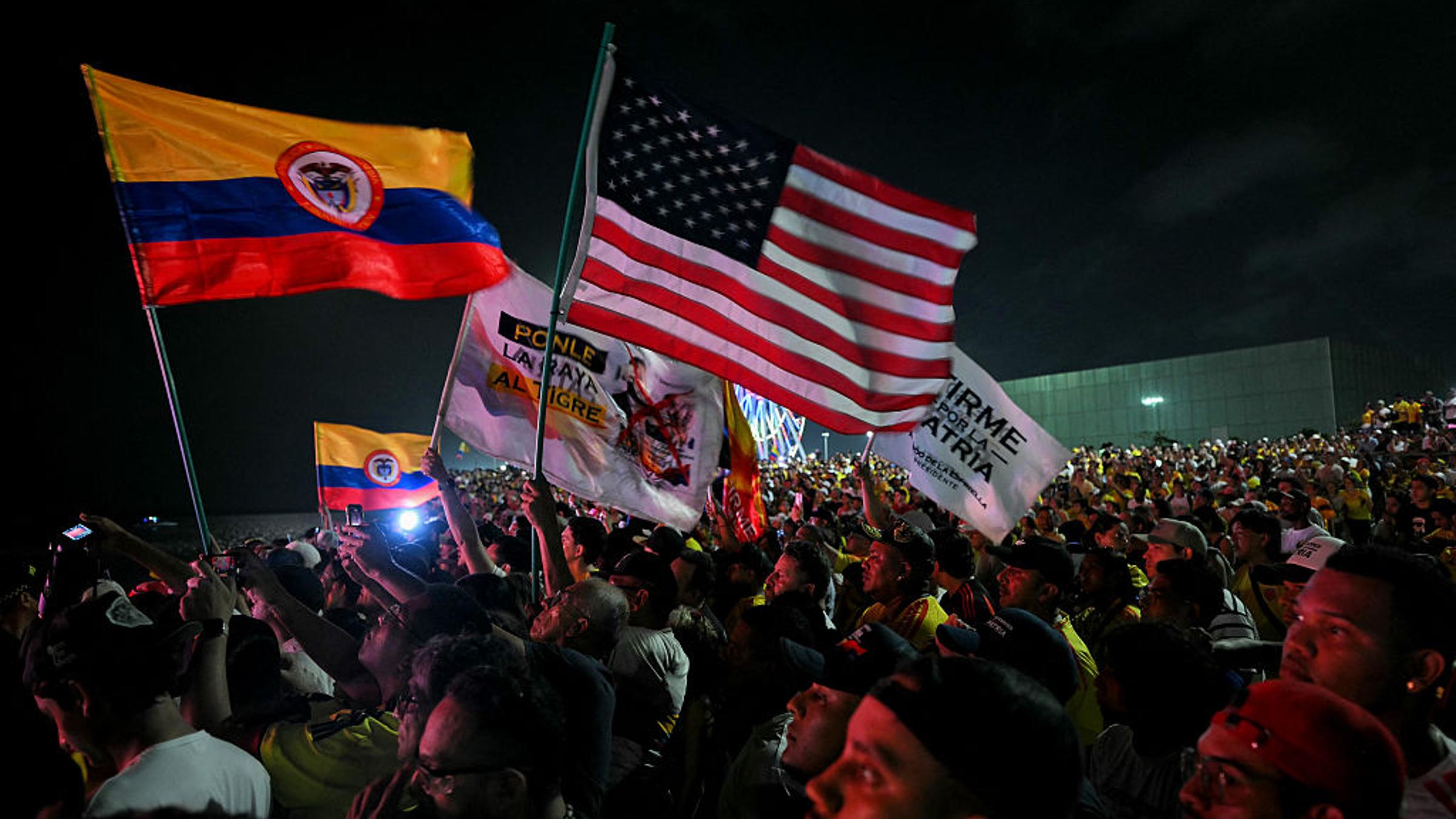
Colombia’s presidential race is headed to a June 21 runoff after Abelardo de la Espriella led the first round with 43.7% and Iván Cepeda followed with 40.9%. The outcome could materially shift Colombia’s stance on security, drug policy, and relations with the U.S. and Israel, but the article is primarily political rather than market-specific. Petro and Cepeda are also challenging the vote-counting process, adding near-term election uncertainty.
The market implication is not the election headline itself, but the regime shift in Colombia’s risk premium if the runoff tips toward a hard-right security platform. A de-escalation of Petro-style uncertainty would likely compress local sovereign spreads and improve bank/utility multiples first, while a Cepeda win preserves policy drift and keeps investors focused on fiscal slippage, FX pressure, and heavier state involvement. The second-order beneficiary of a security-first mandate is the defense and surveillance ecosystem, as any credible 90-day internal-security push would translate into procurement acceleration rather than immediate macro improvement.
The bigger near-term catalyst is not the June 21 vote, but the counting/dispute process. If either camp continues to question legitimacy, Colombia can get a short-lived but tradable risk-off move in COP, local rates, and equities regardless of who ultimately wins. That creates a window where volatility is likely underpriced versus the binary path dependency; the market is likely assuming a clean transition while the article itself points to institutional friction that can drag on for days or weeks.
Contrarian take: the consensus may be overestimating how much a rightward shift would mechanically help assets tied to growth. A tougher security stance could be bullish for FX and banks, but it also raises execution risk for fiscal spending, civil liberties backlash, and judicial constraints, especially if the winner lacks congressional depth. Conversely, a Cepeda outcome may be less market-hostile than feared if it forces continuity on negotiated security policy while avoiding a disruptive foreign-policy break with the U.S. The cleaner trade is therefore volatility and relative value, not a blunt directional bet on Colombia equities.
AI-powered research, real-time alerts, and portfolio analytics for institutional investors.
Request DemoOverall Sentiment
neutral
Sentiment Score
-0.05
