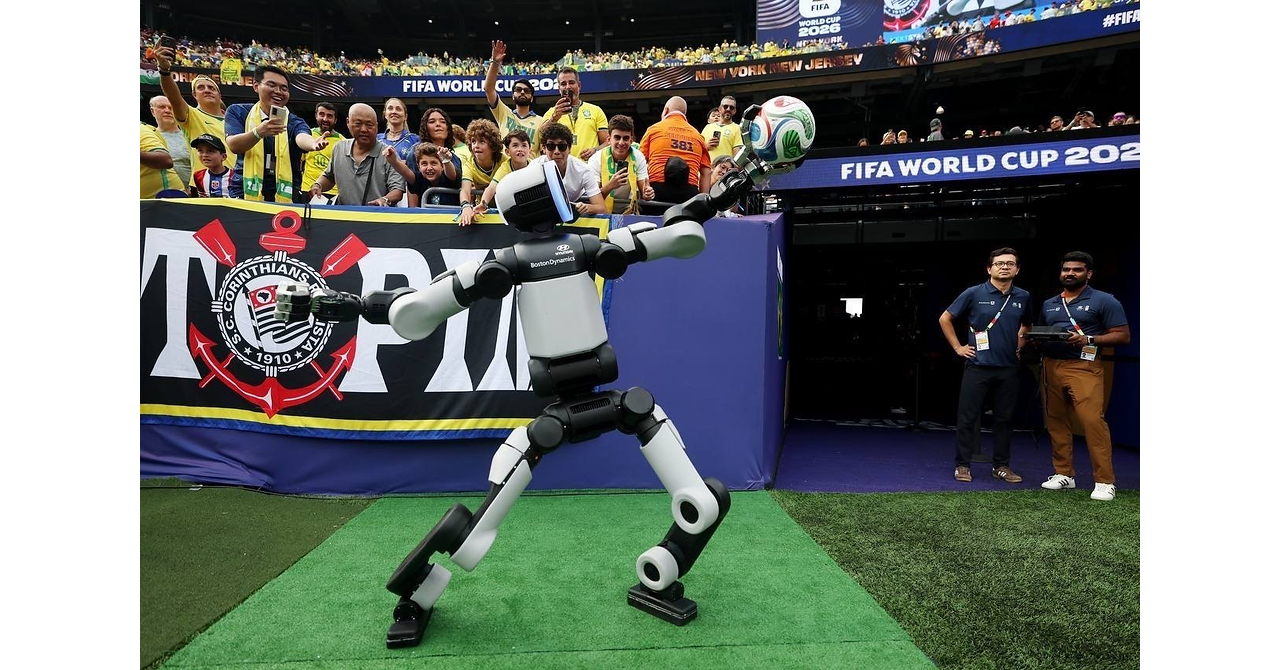
Hyundai Motor integrated Boston Dynamics’ Atlas humanoid robot into FIFA World Cup 2026 during the Round of 16 halftime activation at New York/New Jersey Stadium, marking the first live FIFA World Cup deployment of a humanoid robot. The activation showcased Atlas’ production-version mobility—first demonstrated publicly at CES 2026—using retargeting, reinforcement learning, and whole-body control to execute football-inspired goal celebrations and deliver the ceremonial match ball. The news is a brand/technology milestone with limited direct financial implications in the near term.
This is mostly an option-value event for Hyundai, not an earnings event. The market should treat it as a proof-of-concept that can narrow the “science project” discount on robotics, but the cash impact is still remote unless Hyundai starts disclosing robotics revenue, factory productivity gains, or service contracts. The immediate winner is the Hyundai/Boston Dynamics narrative; the larger second-order beneficiary is any automation vendor with real industrial deployment history, because live-environment credibility raises the probability that corporate buyers revisit capex plans.
The main loser is the speculative humanoid complex if investors start pricing consumer/warehouse adoption as nearer-term than it is. Pure-play robotics names with no manufacturing or field-service traction are most vulnerable to multiple compression once the excitement fades, while incumbents like ABB and TER may benefit from a “show me the ROI” re-rating. Time horizon matters: the brand lift is days, follow-up content/documents can keep it alive for 1-3 months, but the structural payoff is 6-18 months and depends on whether Hyundai converts demos into internal deployments.
Contrarian view: the consensus may be overstating the commercialization signal. A stadium demo proves marketing sophistication and technical reliability under controlled constraints; it does not prove unit economics, safety certification, or customer willingness to pay. Falsifiers are simple: no robotics segment disclosure at the next earnings call, no capex commentary, or any operational glitch that undermines the “trusted partner” message.
AI-powered research, real-time alerts, and portfolio analytics for institutional investors.
Request DemoOverall Sentiment
mildly positive
Sentiment Score
0.25
Ticker Sentiment
