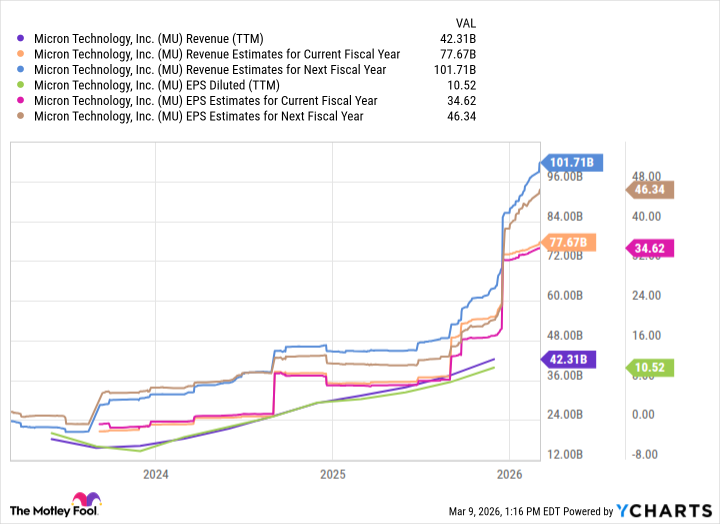
Micron shares rallied 239% in 2025 and are up ~33% YTD in 2026 as hyperscaler AI capex and GPU/HBM demand accelerate. Management sees the HBM market growing ~40% CAGR to $100B by 2028; Micron is sold out for the year and DRAM/NAND prices have risen roughly 60% and 38%, respectively, supporting pricing power and margins. At a forward P/E of ~11 (about half the Nasdaq‑100), the analyst view is that Micron could feasibly double in five years, with a stretched bull case citing a $1,000 stock price and potential trillion‑dollar valuation.
The market is pricing a structural shift in memory demand, but the core dynamic is execution risk framed by capital intensity: wafer starts and advanced packaging capacity take 12–24 months to add, so near-term pricing power can persist even if orders rebase next year. That creates a window where margins can expand materially, but also concentrates risk — a single large buyer pause or a one-quarter inventory destocking will cascade through revenue and ASPs faster than new capacity can be turned on.
Second-order beneficiaries are outside the headline memory makers: OSATs, interposers/substrate suppliers, and high-end test houses will see utilization and pricing power before the chipmakers fully capture margin expansion; conversely, commodity NAND channels and refurb markets will pick up distressed supply if a cyclical turn occurs. Technological and architectural risk is asymmetric — a meaningful shift toward memory-sparse model architectures or on-package integration that reduces HBM per-AI-unit would shave demand growth materially, while incremental model size increases are much less likely to reverse trends quickly.
Leading indicators to watch (on a weekly-to-quarterly cadence) are hyperscaler capex cadence and guidance, wafer fab utilization and tool lead times, HBM ASPs and backlog days, and competitor fab ramp announcements. These will tell you whether current pricing is a sustained structural move or a front-loaded squeeze; trade P&L should be sized to the fact that mean reversion in memory cycles can be abrupt and severe within 3–9 months if oversupply begins to materialize.
AI-powered research, real-time alerts, and portfolio analytics for institutional investors.
Overall Sentiment
strongly positive
Sentiment Score
0.70
Ticker Sentiment
