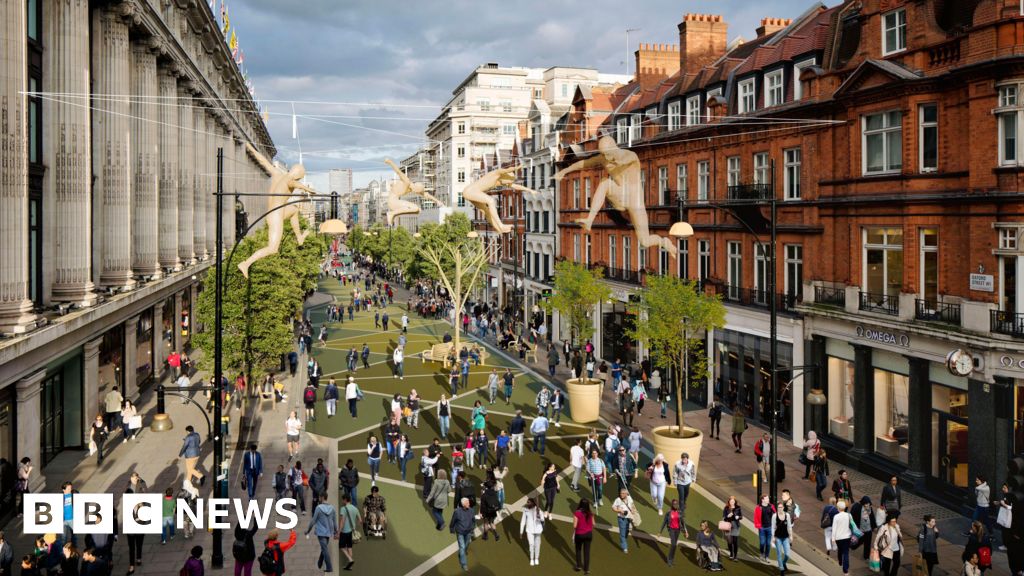
London Mayor Sadiq Khan has given final approval for pedestrianising Oxford Street between Great Portland Street and Orchard Street, instructing TfL to stop vehicle use (with service/delivery access limited to midnight–07:00) and to reroute buses via Wigmore Street and Henrietta Place; implementation aims to stop vehicles by September. The decision follows a second consultation (2,700 respondents) and an earlier poll showing 63% support, and includes new pedestrian crossings, bus stops, potential blue-badge bays and monitoring of traffic displacement — a development likely to boost retail footfall and long-term commercial real estate positioning in the area while creating short-term transport and local access impacts.
Market structure: Prime Oxford Street landlords and ground-floor retail tenants are the clear beneficiaries — reduced vehicle congestion should raise pedestrian dwell time and conversion; expect a 5–15% relative uplift in footfall vs. nearby secondary high streets over 12–24 months, improving pricing power for prime retail leases. Losers are peripheral shopping-centre landlords and small delivery-dependent retailers who face higher last-mile costs and potential short-term revenue displacement; local bus/taxi operators see routing friction but negligible revenue impact (TfL estimates <1-minute journey time increase).
Risk assessment: Tail risks include legal challenges, major accessibility/blue-badge disputes forcing design reversals, or TfL budget overruns (>£50–100m) that delay roll-out — each could wipe out early upside. Immediate (days-weeks) risks are political protest and detailed design tweaks; short-term (weeks–months) hinge on construction disruptions and retailer fit-out; long-term (1–3 years) depend on sustained footfall and rent reversion. Hidden dependencies: growth depends on coordinated retail promotions, events calendar, and night-time economy policies; catalyst set includes TfL/Westminster funding release and Springboard footfall reports.
Trade implications: Tactical long exposure to prime London retail REITs vs. shorts on non-prime mall owners is warranted. Consider using 6–12 month call spreads to express asymmetric upside in Landsec (LAND.L) and British Land (BLND.L) while buying put spreads on Hammerson (HMSO.L) or other regional mall plays; add 12-month small longs in logistics REIT Segro (SGRO.L) to capture last-mile demand.
Contrarian angle: Consensus underestimates the logistics micro-market uplift (midnight delivery windows create demand for consolidation centres) and overestimates pure retail winners if landlords must underwrite street retrofit costs. Historical parallels (NYC pedestrian schemes, European high-street pedestrianisations) show value often accrues to owners after 12–36 months, not instantly — so front-loading options with staged sizing is prudent.
AI-powered research, real-time alerts, and portfolio analytics for institutional investors.
Request TrialOverall Sentiment
mildly positive
Sentiment Score
0.28
