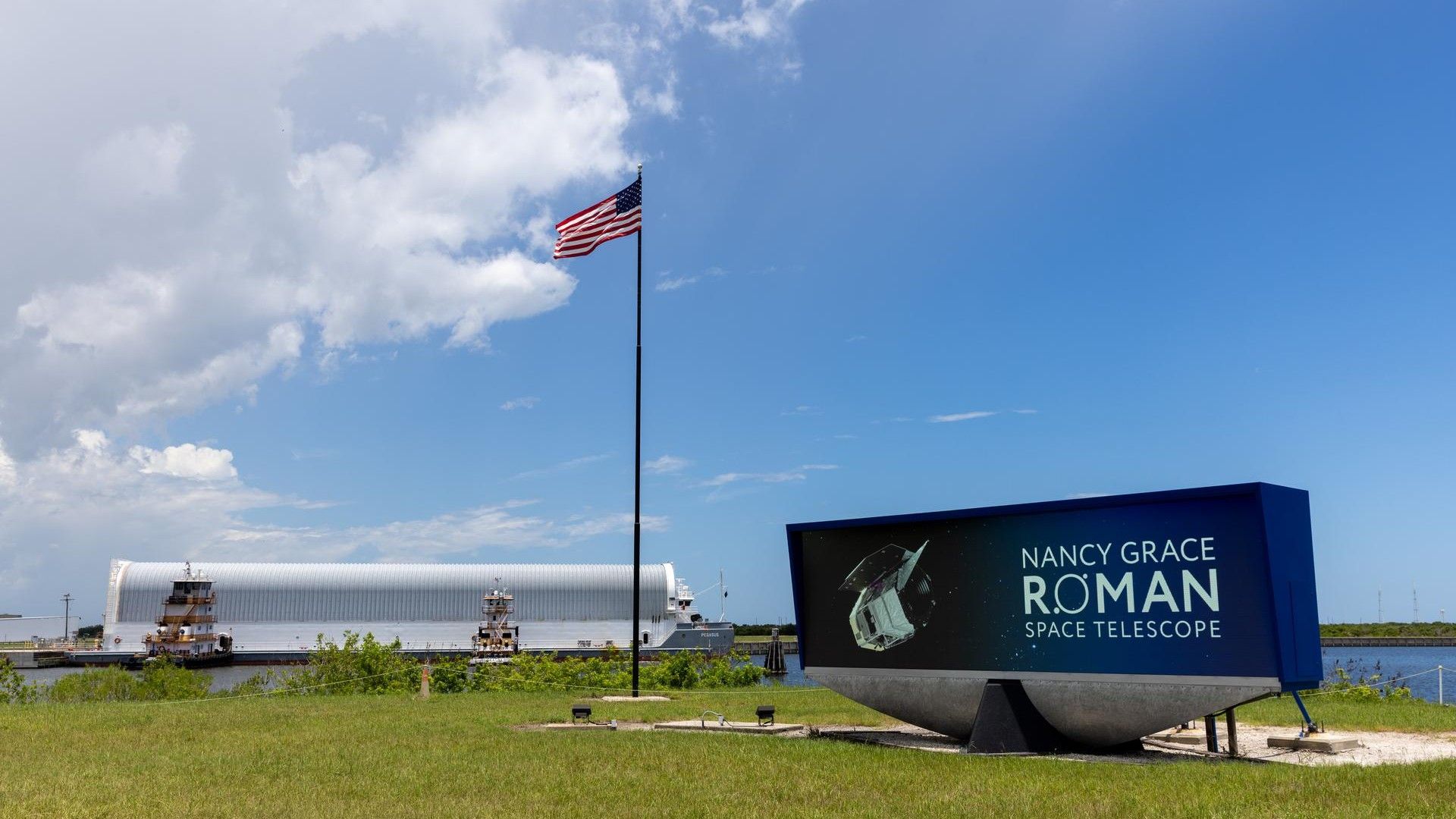
NASA's Roman Space Telescope arrived at Kennedy Space Center on June 21 ahead of a targeted Aug. 30 SpaceX Falcon Heavy launch, putting the mission roughly eight weeks ahead of its original schedule. The spacecraft will undergo final testing, fueling with about 290 gallons of hydrazine, and prelaunch preparations before heading to Sun-Earth L2 for a planned five-year primary mission, extendable if fuel and instruments remain healthy. The article is operational and scientific in nature, with limited direct market impact.
This is a modestly positive signal for the space infrastructure chain, but the bigger implication is schedule credibility: an acceleration into late summer reduces the probability of a long, expensive prelaunch drift that usually bleeds through specialized launch services, mission integration, and ground-support vendors. The market should care less about the telescope itself and more about the fact that NASA is effectively pulling forward a large, high-visibility payload into the launch window when ride-share and dedicated heavy-lift capacity are tight.
Second-order winners are the companies with exposure to heavy-lift cadence and mission-assurance bottlenecks. A successful rollout would reinforce the value of SpaceX’s launch integration stack and support pricing power for scarce Falcon Heavy missions, while also benefiting the broader Florida ground-services ecosystem and suppliers tied to cryogenic, hazardous-fuel handling, clean-room processing, and radiation-hardened components. The more subtle beneficiary is every adjacent payload competing for launch slots: a clean launch here lowers perceived execution risk across the civil-space backlog and can shorten procurement cycles for follow-on science missions.
The main risk is not launch demand but execution slippage. Any contamination, fueling, or post-transport anomaly would likely create a multi-week to multi-month delay, which matters because a flagship science payload is exactly the kind of program where minor issues can trigger conservative re-test requirements and knock-on schedule moves. In the near term, that argues for watching the launch manifest and KSC readiness rather than the headline mission; over the next few months, the trade is really on whether the accelerated timeline is preserved or reverts toward the original cadence.
Contrarian view: the market may overestimate the economic impact of a single NASA flagship launch on listed space names. The real value is in proving repeatability and shortening cycle times, not in one mission’s revenue contribution. If this launch goes cleanly, the more durable takeaway is that the space ecosystem becomes easier to finance and insure, which favors the larger, lower-beta infrastructure names more than the high-flying pure plays.
AI-powered research, real-time alerts, and portfolio analytics for institutional investors.
Request DemoOverall Sentiment
mildly positive
Sentiment Score
0.18
