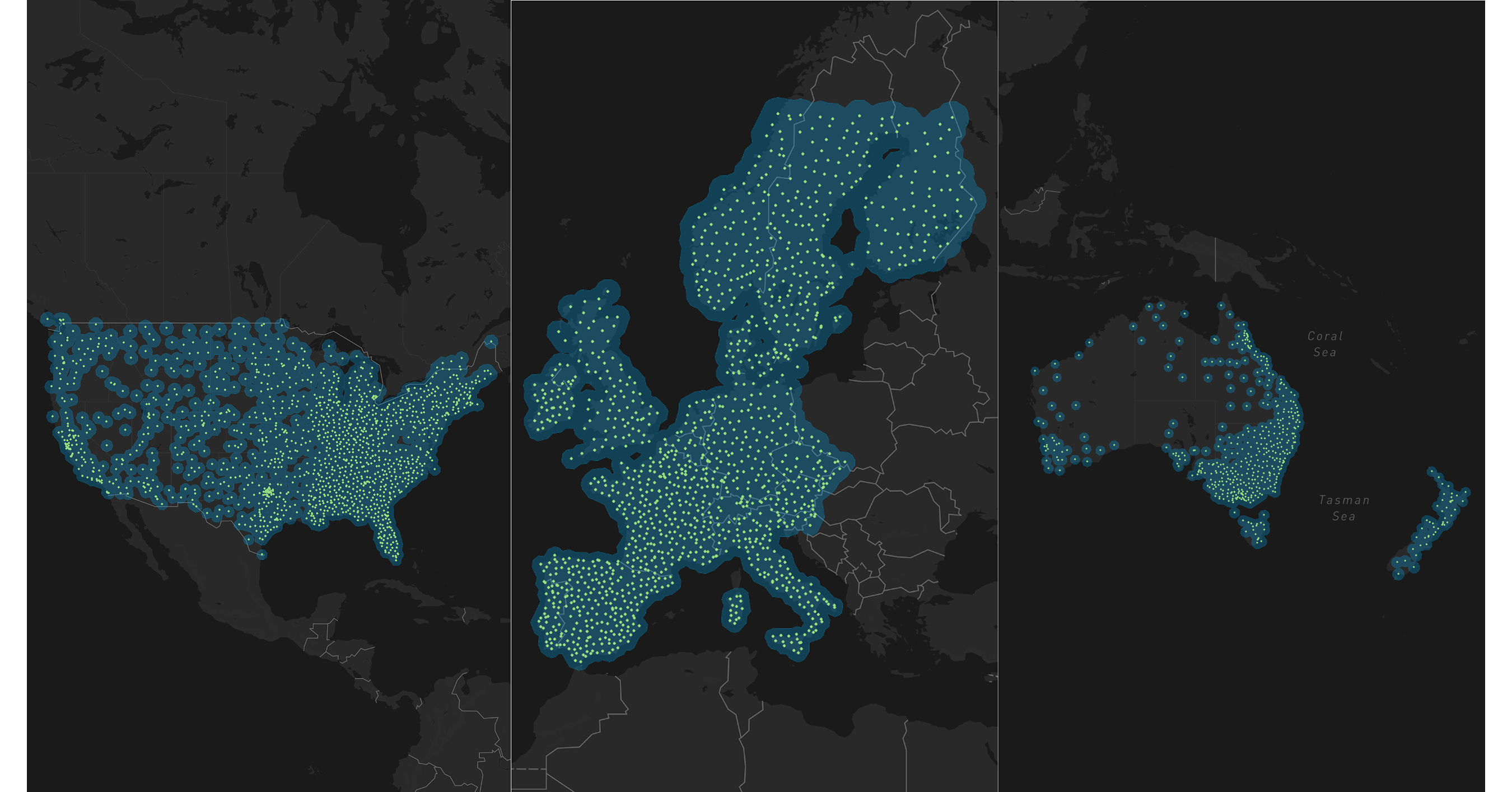
Point One Navigation launched Network RTK delivery for its True RTK flagship service, letting customers configure per device or deployment between single-baseline and network-mode corrections under the same license—without hardware changes or new contracts. The company claims shared ~1–2 cm accuracy and near-instant Fix times across both modes, with Network RTK extending usable range to roughly 60–70 km (vs ~50 km single-baseline) and improved outage resilience. Network RTK uses VRS-style synthesized corrections delivered over standard RTCM, supported via its Device Management GraphQL API, and is available immediately across the US, UK, EU, Australia, and New Zealand.
This is less a product launch than a distribution upgrade: it reduces the friction of buying centimeter-precision as a utility, which should widen the addressable market for fleets that previously avoided base-station complexity. The near-term beneficiary set is not the receiver vendors but the operators that monetize uptime and deployment speed; the downside sits with small correction-service providers and hardware-dependent installers whose moat was workflow lock-in, not technical differentiation.
The second-order risk is commoditization of precision positioning. If standard RTCM receivers can seamlessly shift between correction modes with no hardware change, pricing power migrates toward the network owner and away from any company selling "good enough" localization on sparse infrastructure; over 6-18 months that favors the densest networks and pressures weaker regional alternatives. For public comps, this is a mild negative for geospatial incumbents that rely on bundled software-hardware economics, but the impact is likely gradual rather than an immediate multiple event.
The contrarian view is that the market may overread the competitive threat and underread the retention effect. By broadening use cases without forcing a new SKU or new contract, the launch could improve attach rates and lower churn for the platform owner, while making customers more willing to standardize on one correction layer across fleets. What would falsify the bullish read is weak adoption in autonomous/survey workflows or evidence that customers still prioritize traceability over network flexibility, which would leave this as feature parity rather than a moat expansion.
AI-powered research, real-time alerts, and portfolio analytics for institutional investors.
Request DemoOverall Sentiment
mildly positive
Sentiment Score
0.20
