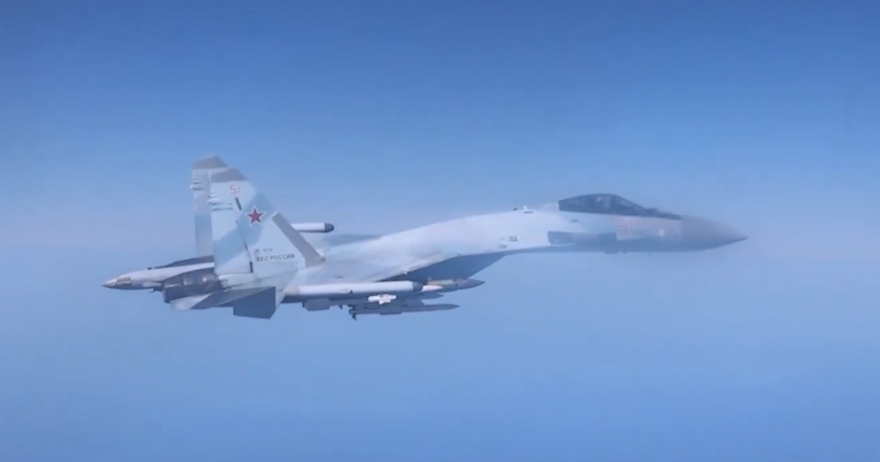
Two Russian jets reportedly intercepted a British RAF Rivet Joint over the Black Sea, with one aircraft coming within six meters and triggering emergency systems on the British plane. The U.K. called the incident dangerous and formally complained to the Russian embassy, underscoring elevated geopolitical and NATO security risks tied to the Ukraine war. While not a direct market shock, the escalation is relevant for defense, airspace security, and broader risk sentiment in Europe.
This is less about the headline incident itself and more about the probability distribution shift it implies: NATO now has to budget for a higher baseline of gray-zone friction around the North Sea, Baltic, and Black Sea corridors. That matters because the incremental cost of persistent ISR, ASW, and air-policing coverage is asymmetric—small adversarial provocations can force materially larger allied responses in aircraft hours, sortie cycles, and readiness wear, which gradually tightens the defense budget conversation across Europe.
The second-order winner is the NATO maritime surveillance and undersea infrastructure stack. Anything tied to anti-submarine warfare, airborne early warning, SIGINT, seabed monitoring, and unmanned persistence should see multi-quarter procurement support, especially in the U.K., Nordics, and allies protecting cable routes. The less obvious beneficiary is defense electronics and mission-systems content, where recurring upgrades to EW, autopilot hardening, and sensor fusion can be funded without waiting for major platform recapitalization.
The bigger risk is a single miscalculation causing a kinetic or electronic escalation event that compresses decision time from months to days. That would likely lift volatility in European defense names while also pressuring insurers, cable-laying contractors, and subsea infrastructure operators if policymakers pre-emptively tighten operating rules or reroute assets. Conversely, if diplomatic backchannels reduce the tempo of intercepts, the headline premium should fade quickly; the durable bull case is not the event, but the structural need for persistent surveillance and undersea deterrence.
Consensus may be underestimating how much this supports budget reallocation away from heavy armor toward maritime/air domain awareness. The market often pays for munitions headlines, but the more durable spend is in sensors, comms, and networked command-and-control because those are the cheapest ways to reduce escalation risk without visibly escalating force posture. In that sense, the incident is a procurement catalyst disguised as a geopolitical nuisance.
AI-powered research, real-time alerts, and portfolio analytics for institutional investors.
Request DemoOverall Sentiment
moderately negative
Sentiment Score
-0.35
