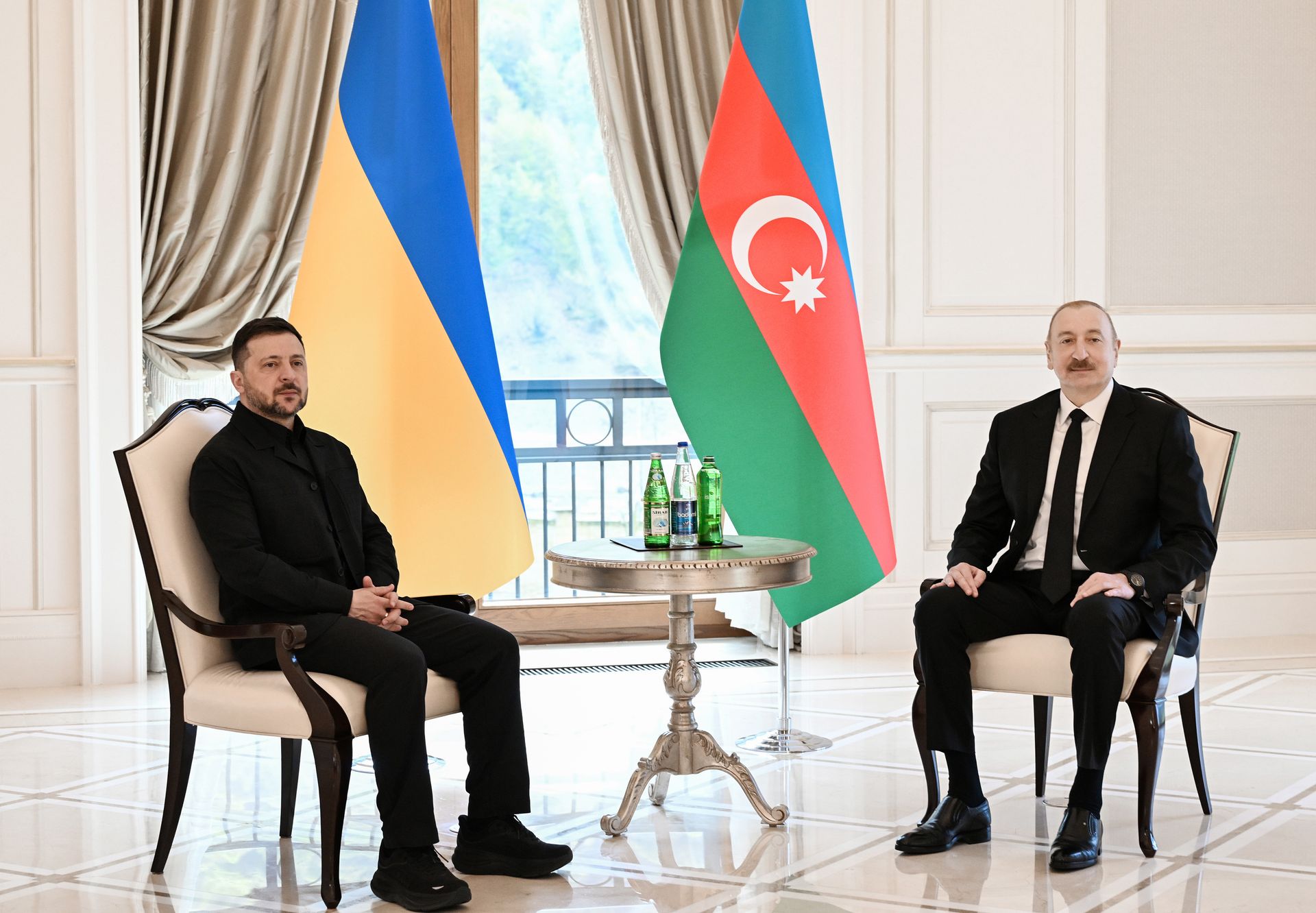
Ukraine and Azerbaijan signed six cooperation agreements during Zelensky’s first wartime visit to Azerbaijan, with talks focused on security, defense-industrial ties, energy cooperation, and humanitarian support. Zelensky said Ukraine is ready for trilateral peace talks with Moscow and Washington in Azerbaijan if Russia is willing to negotiate, while Aliyev said bilateral trade exceeds $500 million and should grow further. The visit reinforces Kyiv’s regional diplomacy but is unlikely to have immediate market-moving impact.
The immediate market read is not on bilateral diplomacy but on optionality: this creates a cleaner pathway for Ukraine to source non-Western defense inputs and energy support without relying on U.S./EU budget politics. The second-order effect is incremental pressure on Russian logistics and air-defense systems over a multi-month horizon if co-production translates into drones, EW components, or repair capacity; that is a real operational risk, but not one that should move broad markets absent proof of scale.
For energy, the more important signal is that Azerbaijan is reinforcing its role as a flexible intermediary between East and West. That supports a modest premium for regional pipeline stability and lessens the odds of a sharp supply disruption in the Southern Gas Corridor, but the bigger macro effect is psychological: Europe gets one more marginal source of diversification, which caps upside in European gas prices unless a broader geopolitical shock emerges.
The contrarian view is that investors may overestimate the near-term tradeable impact. Defense co-production and reconstruction financing are usually slow-moving, procurement-heavy, and vulnerable to political reversals; the time to cash flow is measured in years, not weeks. The real catalyst set is binary: if talks produce a concrete industrial framework or arms-transfer channel, the implications are higher for niche defense suppliers and drone component vendors than for headline EM or energy proxies.
From a risk standpoint, the key tail event is deterioration in Russia-Azerbaijan ties or escalation around Black Sea / Caucasus transit routes, which would raise regional insurance and shipping costs and could temporarily lift European gas risk premia. Conversely, any renewed U.S.-Russia diplomatic channel that reduces the value of Azerbaijan as a mediator would quickly deflate the strategic premium embedded in this relationship.
AI-powered research, real-time alerts, and portfolio analytics for institutional investors.
Request DemoOverall Sentiment
neutral
Sentiment Score
0.15
