



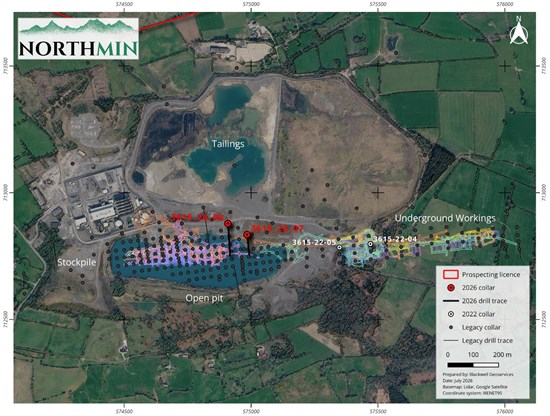
Northmin reported early Tynagh drilling assay results including 6.4m at 4.92% Cu, 0.98% Sb and 62.04 g/t Ag (from 149.0m, incl. 1.95m at 10.08% Cu and 136.46 g/t Ag) in its first two holes. A second highlight included 27.45m at 0.26% Cu, 4.57% Zn+Pb and 20.78 g/t Ag from 90.55m, with zones such as 6.8m at 13.31% Zn+Pb and 48.79 g/t Ag. The company also granted 3,500,000 incentive stock options at $0.25/share expiring July 9, 2028, and said the results support systematic drilling (~1,500m strike) and continuation of its remaining 8 holes of a ~2,000m program this summer.
This is the kind of release that can move a microcap on sentiment, but the investable question is whether the new mineralization is continuous enough to justify a larger system view. In brownfield explorers, isolated high-grade intervals matter less than whether they connect into a mineable corridor with predictable geometry; the market will pay for a repeatable target model, not just tenor. The second-order read-through is positive for other Irish carbonate-hosted explorers and for antimony exposure more broadly, because any credible Cu-Ag-Sb association can re-rate a project faster than a plain zinc-lead story.
The near-term risk is classic discovery disappointment: the first couple of holes often define the best-looking edge of the system, and follow-up drilling can quickly compress the valuation if widths narrow or the structure becomes too complex. The option grant creates a modest supply overhang into the C$0.25 area, where management incentive supply can cap upside even if the stock gets momentum. Over 1-3 months, the real catalyst is whether the remaining holes show strike continuity; over 6-18 months, the question is whether the project becomes financeable as a polymetallic district with tailings/waste optionality helping fund work.
The contrarian point is that the market may be overweighting headline copper grade and underweighting metallurgy, recovery, and tonnage. Antimony and silver are the latent value drivers if recoveries are clean, but if those credits are messy or the structure is discontinuous, the narrative will revert to a standard junior drill-story multiple. Falsify the bullish case if the next holes fail to replicate the same geochemical signature over the fault or if the company shifts from drilling to repeated equity issuance before resource-defining progress.
AI-powered research, real-time alerts, and portfolio analytics for institutional investors.
Request TrialOverall Sentiment
moderately positive
Sentiment Score
0.55
Ticker Sentiment
