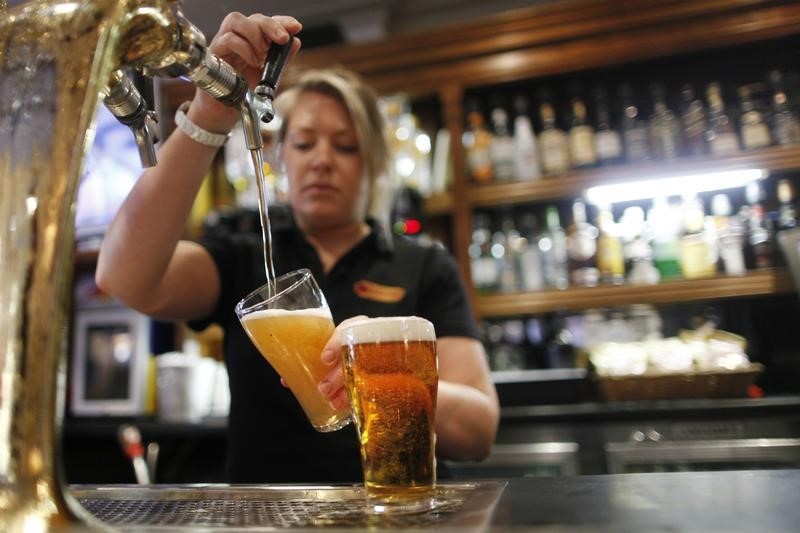
Sapporo will sell Stone Brewing to Firestone Walker and Duvel Moortgat, booking an expected $23 million gain on transfer but also about $80 million in impairment losses. The deal follows a weak U.S. beer market, high competition, and rising input costs, after Sapporo bought Stone in 2022 for roughly $165-$168 million. Shares fell as much as 6.4% on the announcement, though the company will retain its other U.S. operations.
This is less a one-off write-down than evidence that the U.S. craft-beer segment has become a structurally unattractive sink for strategic buyers: weak demand, fragmented distribution, and persistent input inflation make scale harder to monetize than most overseas acquirers expected. The cleanest second-order read is that national and regional brewers with heavy exposure to premium craft are likely to face continued margin pressure, while wholesalers and logistics partners tied to slower-moving, higher-SKU product mixes could see volume compression before any broad category recovery.
The key incremental benefit is not to rival beer brands but to management credibility and capital allocation. By exiting an underperforming asset now, the company reduces the probability of a longer value-destructive turnaround campaign, and that can eventually support a rerating if investors believe U.S. operations are being simplified around core manufacturing rather than brand experimentation. The near-term negative, however, is that the impairment confirms prior goodwill was not just cyclical but mispriced structural decline, which tends to cap multiple expansion for at least 2-4 quarters.
The contrarian angle is that the stock reaction may overstate the cash impact relative to the accounting loss. If the sale proceeds are modestly positive and the remaining U.S. base is preserved, this may actually improve free-cash-flow visibility over 12 months by removing a low-return drag. The bigger risk is that similar underperformance exists in other imported or premium portfolios, which would turn this from a single asset sale into a broader de-rating of Japanese beverage names with U.S. expansion ambitions.
AI-powered research, real-time alerts, and portfolio analytics for institutional investors.
Overall Sentiment
moderately negative
Sentiment Score
-0.45
