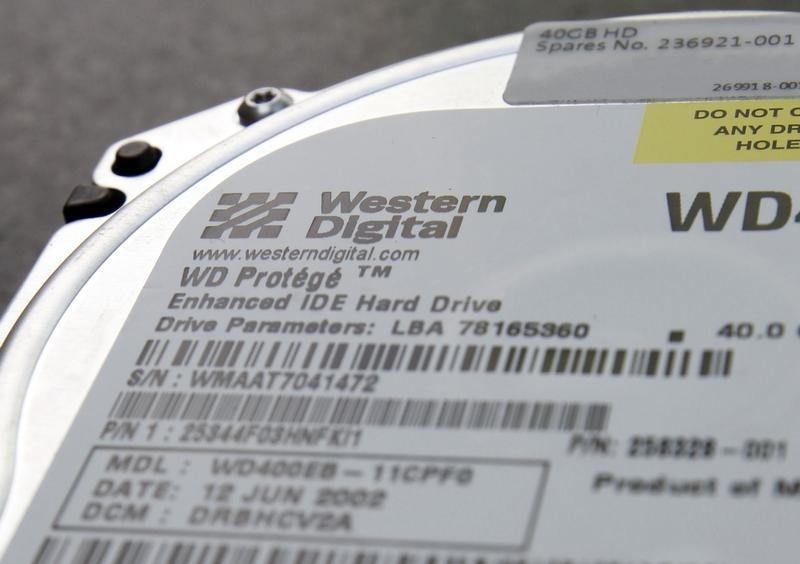
Western Digital surged 14.8% to $646.38 and hit a new 52-week high of $658.80 after a wave of bullish analyst action, including Morgan Stanley lifting its target to $650 from $488 and JPMorgan raising its target to $650 from $530. The company also reported Q3 fiscal 2026 revenue of $3.337 billion, increased its dividend 20%, and authorized a $4 billion share repurchase program, reinforcing confidence in cash generation and AI-driven demand. Broader tech strength and rising storage peers added to the upside.
The market is treating this as a re-rating event, not a one-day squeeze: when multiple top-tier banks converge on the same price zone, it usually becomes a magnet for systematic flows and forced model updates rather than just discretionary buying. The more important second-order effect is that Western Digital’s improving cash conversion can pull forward capital returns across the storage complex, tightening the relative valuation gap versus other AI infrastructure beneficiaries that have larger balance-sheet flexibility but less direct pricing leverage.
The trade is strongest over the next 2-6 weeks if analyst revisions keep propagating through factor screens and momentum funds, but that setup also creates fragility: once the stock approaches the clustered target band, upside can slow sharply unless subsequent data confirms HDD pricing and FCF expansion. A failed breakout would likely come from any sign that supply discipline is easing or that AI demand is being over-embedded into near-term estimates rather than deferred-capex timing.
The underappreciated bull case is that Western Digital can become a capital-return story with technology optionality, which tends to attract a broader shareholder base than a classic cyclical hardware name. The contrarian risk is that consensus may be extrapolating a margin inflection that is still partially dependent on favorable industry supply, so the stock can outperform fundamentals for a while but also de-rate quickly if pricing momentum pauses for even one quarter.
Relative winners include the storage ecosystem and any supplier exposed to incremental HDD/flash capex discipline, while the most obvious loser is the short interest that was leaning on a low-multiple, low-growth narrative. Banks issuing the targets also benefit reputationally if the move sticks, but the real tell will be whether peers can sustain sympathy gains once the initial squeeze fades; that will indicate whether this is a single-name repricing or a broader read-through on AI infrastructure breadth.
AI-powered research, real-time alerts, and portfolio analytics for institutional investors.
Request DemoOverall Sentiment
strongly positive
Sentiment Score
0.82
Ticker Sentiment
