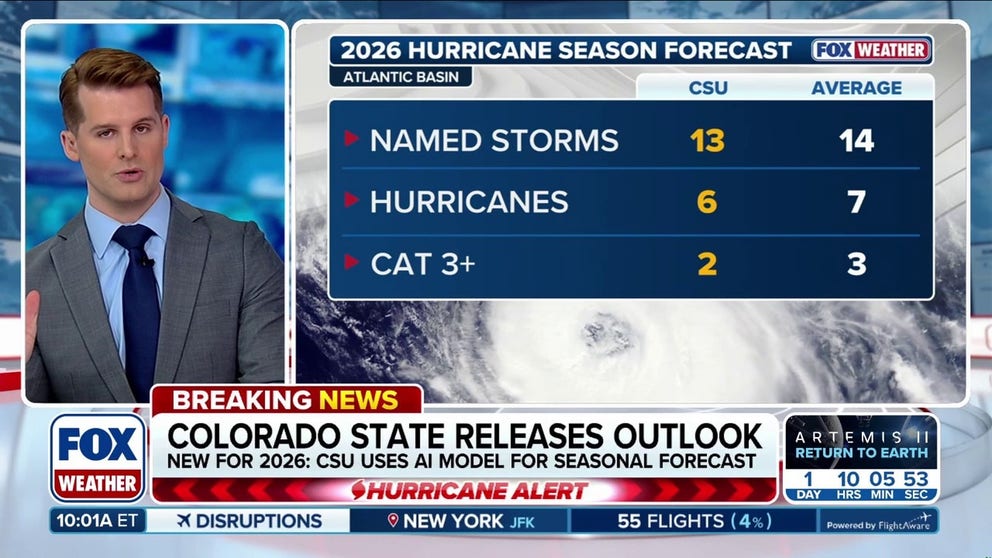
CSU's April forecast calls for 13 named storms, 6 hurricanes and 2 major (Category 3+) hurricanes in the 2026 Atlantic season (vs climatological averages of 14/7/3), citing a strong El Niño expected to dominate and suppress activity. CSU expects vertical wind shear to be the second-highest since 1981 while Atlantic SSTs remain near/above average, creating competing suppressing (shear) and fueling (warm SST) effects; timing/intensity of El Niño will determine net impact. CSU incorporated an AI-based model in this forecast and will issue an update in June; forecasters stress that even an overall quieter season still carries the risk of a single destructive storm.
Primary market consequence is not total storm count but repricing of tail exposure and volatility of that repricing. If models converge on a weaker Atlantic season, capital that would otherwise flow into catastrophe protection (retro, cat bonds, quota-share capacity) is likely to search for yield elsewhere, compressing spreads on ILS and pushing reinsurers to deploy capital into alternative underwriting or buybacks. Conversely, regional property carriers with concentrated coastal exposure face a liquidity mismatch: lower expected losses reduce near-term reserve draws, but balance sheets remain fragile to a single large landfall and will trade more on idiosyncratic solvency metrics than on seasonal headlines.
Timing is the dominant catalyst: the next public inflection is the June forecast cycle and then the peak storm window (Aug–Oct). Those two dates create asymmetric windows for event-driven option plays and reinsurance contract pricing — if El Niño forms late, the market may have already de-risked, creating a sharp upward repricing when Atlantic activity resurges. The incorporation of AI into forecast workflows adds a second-order effect: increased short-term forecast revisions and larger knee-jerk reactions in thinly traded reinsurance-linked securities and small-cap insurers.
Strategically, this is a classic dispersion trade: buy large, diversified balance-sheet protection (reinsurers, well-capitalized global players) and hedge or underweight regional property carriers and muni issuers with concentrated coastal exposure. Maintain explicit tail hedges sized for a 1-in-50 event because a single landfall remains a nonlinear P&L driver; a benign season will reward patience, but losses from a surprise event can wipe out multi-year underwriting gains.
AI-powered research, real-time alerts, and portfolio analytics for institutional investors.
Request DemoOverall Sentiment
neutral
Sentiment Score
0.00
