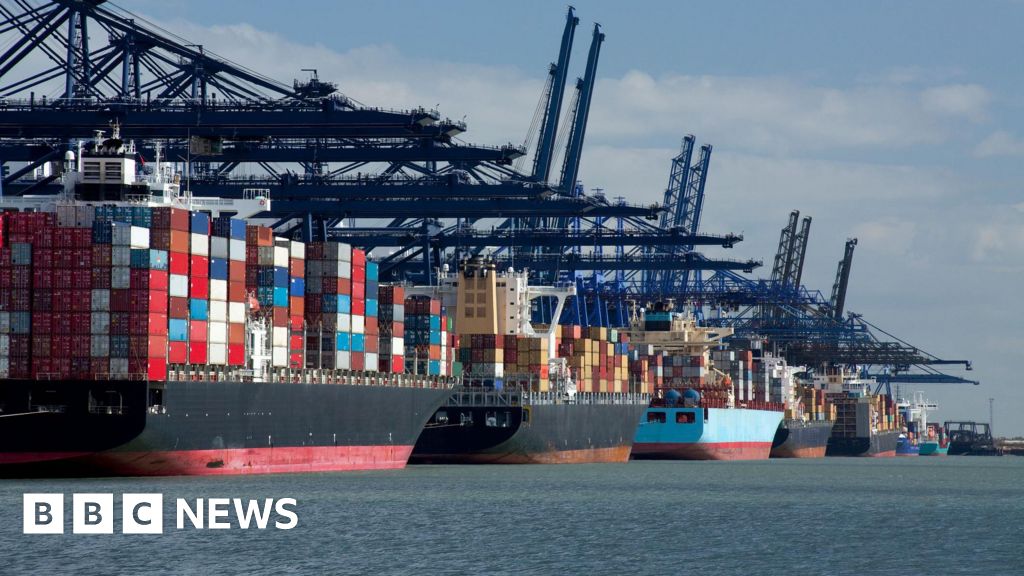
US President Trump's announcement of a proposed 15% global tariff — following a Supreme Court ruling that struck down previous emergency tariffs — would leave the UK among the worst‑hit countries according to Global Trade Alert, despite a prior negotiated 10% bilateral tariff arrangement. Sector‑specific deals (steel, aluminium, pharmaceuticals, autos, aerospace) are reported to be unaffected and US trade representative Jamieson Greer has said negotiated deals should stand, but the policy shift and legal uncertainty raise downside risks for UK trade‑exposed sectors and complicate cross‑border trade planning.
Market structure: A 15% US global tariff raises costs for UK goods into the US — direct losers are UK consumer goods and food exporters (e.g., luxury apparel, whisky) and mid‑cap UK exporters; winners are US domestic producers and countries with higher current tariffs (China, Brazil) who get a relative cut. Expect initial FX and equity moves: GBP likely to test -1.5% to -4% vs USD within days if rhetoric persists; UK equity risk premium could widen 25–75bp on gilts vs bunds over weeks. Risk assessment: Tail risks include full retaliatory tariffs (low probability, high impact) or quick policy reversal via courts/negotiations; those would swing markets violently. Near term (days–weeks) volatility and FX moves dominate; medium term (3–12 months) expect supply‑chain re‑routing and permanent market‑share shifts; long term (1–3 years) potential reallocation of FDI from the UK. Hidden dependencies: many big UK exports (pharma, autos, aerospace) are carved out so headline impact is concentrated, not uniform. Trade implications: Implement directional FX and UK equity trades: short GBP (FXB) and short UK equity exposure (EWU) while going long USD (UUP) and gold (GLD) as protection. Use options to define risk: buy 3‑month EWU put spread (sell -10% strike, buy -15% strike) and buy UUP 3‑month calls if GBP breaks -3%. Rotate from UK consumer discretionary into US domestic industrials/defense (1–3% reweights) over 2–8 weeks. Contrarian angles: Consensus may overstate broad UK damage — with pharma/auto/aero exempt, high‑quality multi‑nationals with pricing power (e.g., DGE.L, RIO.L) could be oversold; shorting the whole UK indiscriminately risks mean reversion. Historical tariff shocks (2018) show sharp initial repricing then partial recovery; watch 30–60 day negotiation signals and US congressional pushback as catalysts to reverse positions.
AI-powered research, real-time alerts, and portfolio analytics for institutional investors.
Request DemoOverall Sentiment
moderately negative
Sentiment Score
-0.45
