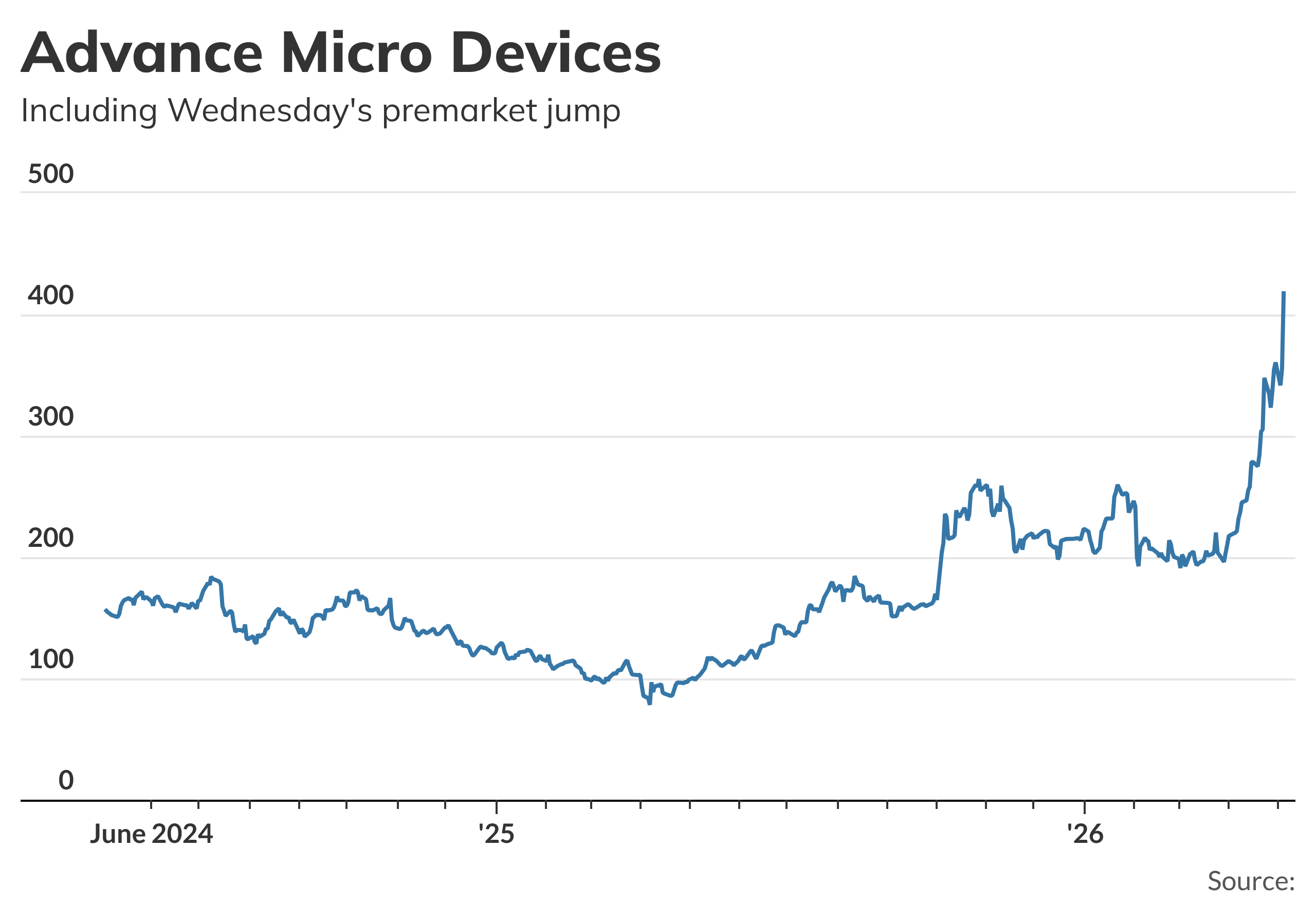
AMD jumped nearly 19% to a record high after first-quarter earnings and an upbeat AI outlook, while Super Micro Computer rose more than 17% despite a revenue miss as gross margins rebounded. Novo Nordisk gained nearly 6% on faster-than-expected take-up of its Wegovy pill, while Arista Networks fell more than 7% despite beating forecasts and Upstart dropped 10% on a weaker-than-expected first quarter.
The cleanest takeaway is not “AI hardware is strong,” but that capital is rotating toward the names with the most credible near-term monetization path and away from the ones whose upside is already embedded. AMD’s move likely forces systematic reallocations within semis: if investors start treating it as a viable AI infrastructure alternative, that becomes a relative-negative for the most crowded winners in the GPU/AI stack and a positive for second-tier compute, memory, packaging, and interconnect exposure. The second-order effect is that suppliers tied to accelerated compute could see order-mix improvement even if unit volumes don’t accelerate meaningfully.
SMCI and ALAB strength suggests the market is rewarding margin recovery and attach-rate leverage more than top-line purity. That matters because it implies a softer earnings bar for adjacent infrastructure names if they can show even modest gross margin stabilization; conversely, suppliers with pristine growth but weak pricing discipline could get punished more harshly. ANET’s drop despite a good report is a classic “good news, bad positioning” setup, and often precedes a multi-week de-rating if large holders use strength to reduce exposure.
NVO’s reaction says the market is still underestimating how quickly obesity treatment can expand from chronic therapy into a mass-adoption category. The key second-order effect is downstream pressure on other obesity and metabolic names that depend on an assumption of slower uptake or higher discontinuation; if a pill format improves convenience and adherence, it compresses the timeline for share shifts. Upstart remains structurally vulnerable because any miss in this tape gets interpreted as evidence that AI alone cannot compensate for cyclical credit fragility.
The contrarian angle is that several of these moves look more like positioning squeezes than durable fundamental repricings. AMD and SMCI could face a “show me” quarter after the initial gap if AI capex broadens less than expected, while ANET may actually become interesting on a reset if it was sold for flow rather than deteriorating fundamentals. The most dangerous assumption is extrapolating one strong AI-quarter into a straight-line 12-month growth regime; the market is likely to discover in the next 1-2 earnings cycles whether this is real acceleration or just timing pull-forward.
AI-powered research, real-time alerts, and portfolio analytics for institutional investors.
Request DemoOverall Sentiment
moderately positive
Sentiment Score
0.45
Ticker Sentiment
