
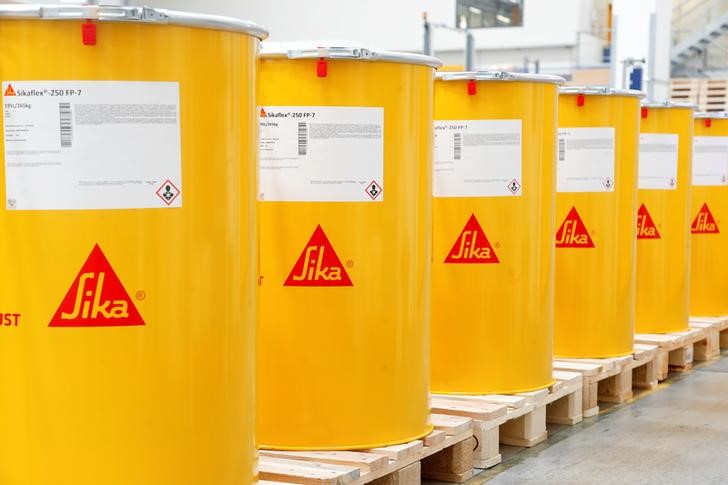
Sika shares rose over 8% after first-quarter sales of CHF 2.49 billion beat the CHF 2.45 billion consensus, with organic revenue down just 0.2% versus expected declines of roughly 1.7% to 1.8%. Asia Pacific outperformed sharply, while Europe, Middle East and Africa improved sequentially and the Americas were softer due to winter storms and uncertainty. The company reaffirmed 2026 guidance for 1% to 4% local-currency sales growth and a 19.5% to 20% EBITDA margin, even as management flagged Middle East risks and cautious market conditions.
The key market implication is not the headline beat, but the quality of the beat: demand is holding up better in the regions that typically lead the cycle, while the weakness is still concentrated in the slowest-to-recover areas. That makes this less of a “growth is back” signal and more of a validation that the company is gaining share or execution advantage while the underlying construction cycle remains soft. In that setup, suppliers with weaker mix or less pricing discipline are the likely losers, because volume is not strong enough to hide subpar regional exposure.
The bigger second-order effect is FX and geopolitics. A strong Swiss franc is already masking underlying operating momentum, so any further CHF strength would keep reported growth visually depressed even if local demand stabilizes. At the same time, elevated Middle East risk matters less through direct damage and more through contractor caution: project starts, procurement timing, and inventory decisions tend to slow before any physical disruption shows up, which can delay a recovery for several quarters.
The guidance reset is where the skepticism sits. Management is effectively signaling that margins are being defended through productivity rather than end-market acceleration, which usually works until it doesn’t: if pricing softens or energy/logistics costs re-accelerate, the margin bridge becomes fragile. Consensus likely underestimates the probability that organic growth stays near flat for longer than the market expects, which caps multiple expansion despite the better-than-feared print.
Contrarian view: the stock may already be pricing in a worse macro backdrop than the one actually unfolding. If Europe keeps improving sequentially and India/SEA remain the marginal growth engine, Sika can hold revenue better than the broader construction complex even without China recovery. The real upside trigger is not a return to high growth, but proof that the business can sustain mid-single-digit local-currency growth with stable margins despite a muted cycle.
AI-powered research, real-time alerts, and portfolio analytics for institutional investors.
Request TrialOverall Sentiment
mildly positive
Sentiment Score
0.25
Ticker Sentiment
