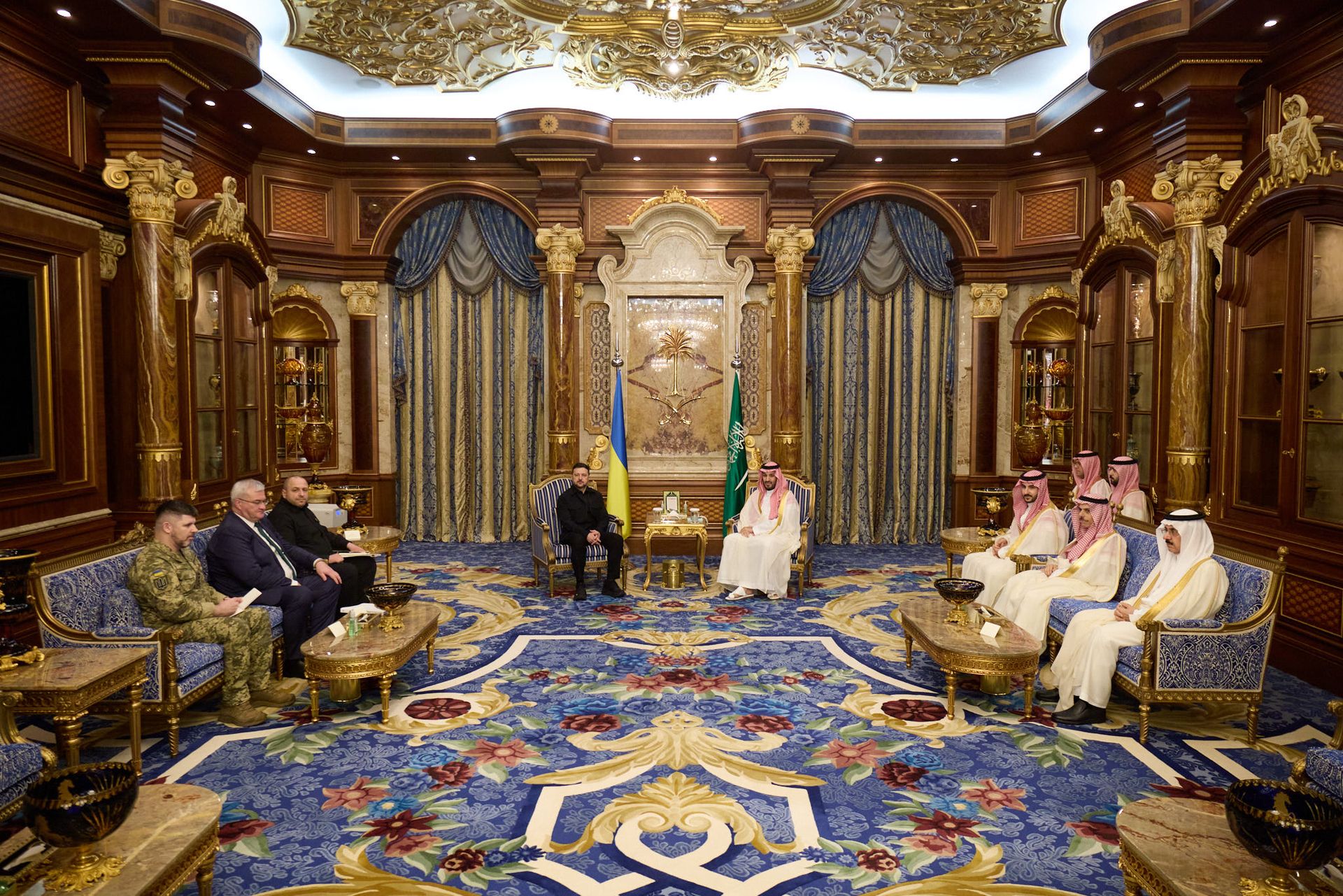
Ukraine and Saudi Arabia are deepening cooperation in security, energy, infrastructure, air defense, and food security, following a prior March 27 meeting in Jeddah. The EU also approved a 90-billion-euro ($106-billion) loan for Kyiv and a 20th sanctions package against Russia on April 23, providing additional support for Ukraine amid the war. The article is geopolitically significant but has limited direct near-term market impact.
This is less about a bilateral photo-op than about the creation of an alternate procurement and financing stack for air defense and counter-drone systems. Gulf states are being pushed to buy faster, more modular defenses after recent missile/drone exposure, which favors suppliers with combat-proven, rapidly integrable sensor-to-shooter architectures over legacy platform vendors. The second-order beneficiary is not just the obvious defense primes, but the broader ecosystem of radars, C2 software, electronic warfare, and interceptors that can be delivered in small lots and scaled quickly.
The strategic read-through for markets is that Ukraine is converting battlefield data into an exportable product edge. That matters because procurement cycles in the Gulf are typically long, but the recent threat environment compresses decision timelines from years to months; the winners should see order book visibility improve before revenue does. The infrastructure angle also creates a financing tailwind for logistics, hardening, and energy-resilience contractors as states look to protect ports, grids, and desalination assets rather than just buy hardware.
The main risk is that enthusiasm outpaces actual budget appropriation and interoperability work. If Gulf states split purchases across multiple suppliers, the incremental economics dilute quickly, and any cooling in regional threat perception could defer orders back into 2026. Sanctions pressure on Russia adds a medium-term support to the defense narrative, but the bigger market tell will be whether Gulf procurement agencies convert MoUs into funded programs within the next two quarters.
Consensus is probably underestimating the beneficiaries outside pure defense: cyber, perimeter security, power backup, and critical infrastructure automation could capture a quieter but more durable spending wave. The overdone assumption is that this is immediately a headline defense-order trade; in practice the cleaner expression may be a basket of defense-electronics and industrial-resilience names, where multiple contract layers can compound even if one program slips.
AI-powered research, real-time alerts, and portfolio analytics for institutional investors.
Request TrialOverall Sentiment
mildly positive
Sentiment Score
0.20
