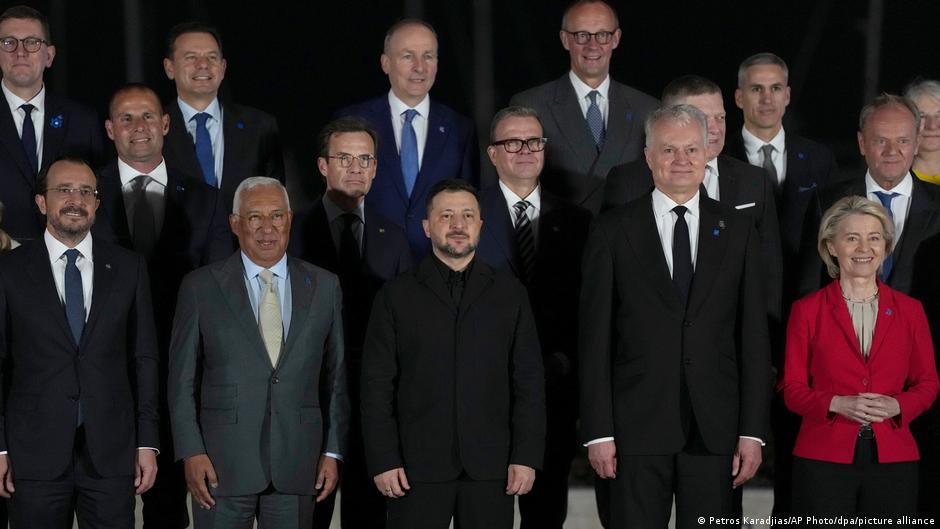
EU leaders approved a €90 billion ($105 billion) loan to Ukraine and agreed to additional sanctions on Russia, while also discussing the Ukraine war and Middle East conflicts at the Cyprus summit. Leaders highlighted concerns over Iran’s closure of the Strait of Hormuz, which has pushed energy prices higher and may threaten about 20% of EU jet fuel imports. The bloc also began debate on its 2028-2034 budget, which the EU executive wants to expand to roughly €2 trillion ($2.3 trillion).
The immediate market implication is not the headline political signaling but the extension of Europe’s quasi-fiscal backstop into a war economy. That tends to support EU defense supply chains, grid equipment, drones, electronic warfare, and reconstruction names more than broad cyclicals, because the spend mix is shifting toward hard-to-source industrial content with faster procurement cycles. The second-order effect is margin pressure on European utilities and transport from sustained fuel volatility, while airlines and chemicals face a more persistent input-cost shock if Hormuz risk keeps diesel and jet spreads elevated.
The Ukraine financing removes a near-term liquidity overhang, but the bigger effect is duration: it reduces the probability of a forced negotiation regime and extends the runway for military procurement and infrastructure replacement over the next 6-12 months. That is constructive for firms with exposure to munitions, drones, power restoration, and satellite/communications resiliency, but it also raises the odds of retaliatory Russian escalation against energy and grid assets, which could create periodic risk-off spikes rather than a smooth trend.
The Hormuz issue is the cleaner macro catalyst because the market is underestimating the lag between crude moves and downstream European inflation. Jet fuel is a particularly underappreciated transmission channel; if elevated prices persist for multiple weeks, EU CPI prints can reaccelerate even without broader goods inflation, which would keep the ECB boxed in and cap rate-cut expectations. The consensus may be overfocused on temporary ceasefires and underfocused on how quickly shipping insurance, refining cracks, and fuel inventories can tighten before any diplomatic de-escalation arrives.
For the budget discussion, the key read-through is that defense and competitiveness spending will likely crowd out lower-priority fiscal categories over the next multi-year framework. That should support defense primes and selected industrial automation names, but it also increases the chance of political resistance to common funding, making execution risk high and keeping sector dispersion elevated.
AI-powered research, real-time alerts, and portfolio analytics for institutional investors.
Request TrialOverall Sentiment
neutral
Sentiment Score
0.05
