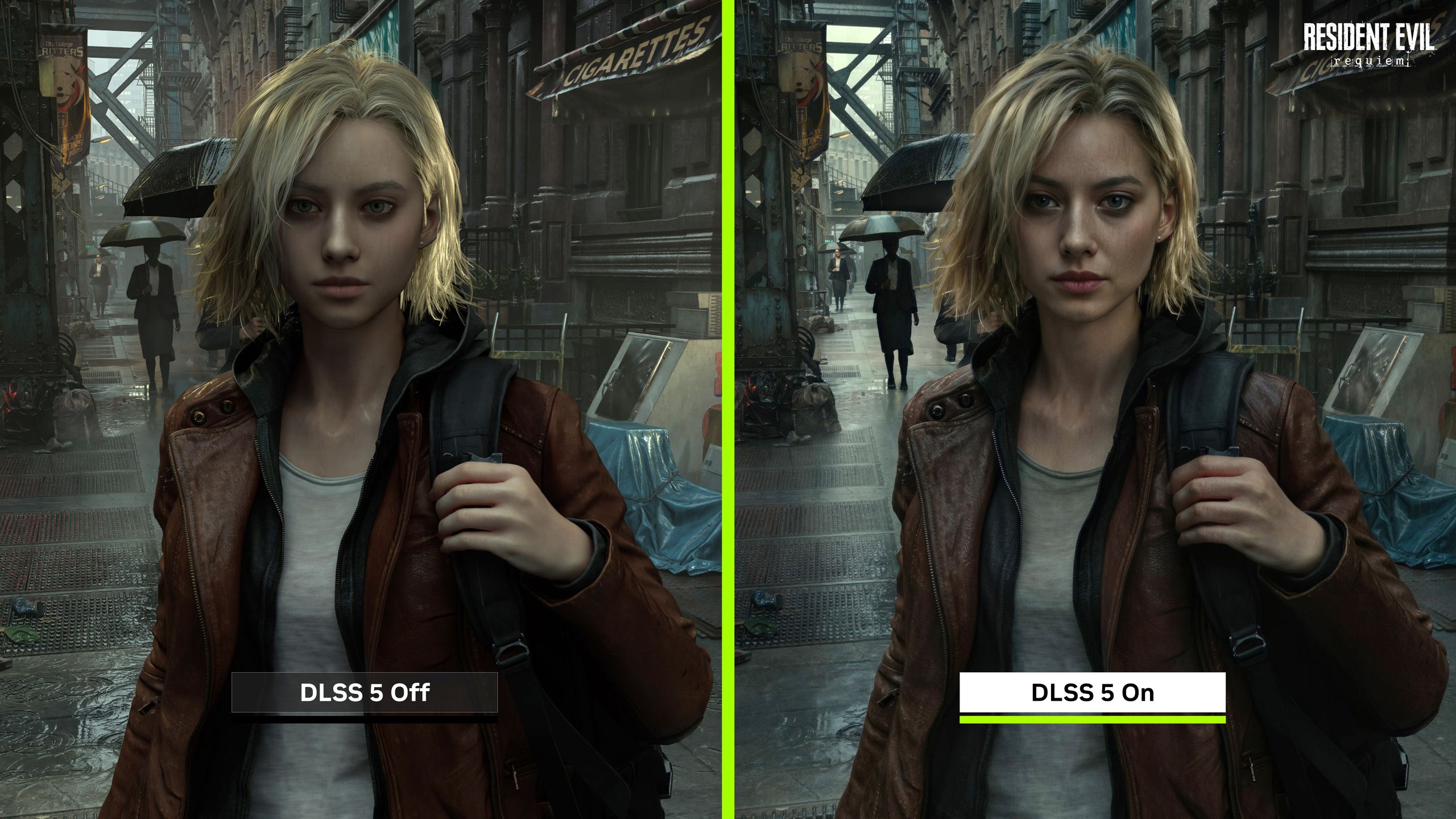
Nvidia's announcement of DLSS 5 — a generative-AI neural rendering upgrade to its upscaling tech — triggered notable developer backlash after demo changes to characters (notably in Resident Evil Requiem) created viral criticism and memes. Capcom employees reportedly were surprised by the announcement, while Bethesda emphasized artists will retain control and Nvidia CEO Jensen Huang defended the controllability of the system. Implication: short-term reputational and adoption risk among developers and consumers, though Nvidia positions DLSS 5 as a controllable tool rather than an automated replacement for artists.
Nvidia’s DLSS 5 demo creates a classic platform tension: the technology can materially raise perceived graphics quality while simultaneously shifting control and pipeline costs toward the SDK provider. Expect developer ops to demand per-game controls, provenance tooling, and QA cycles — a multi-quarter integration cost that favors larger studios and increases switching costs for developers who standardize on NVIDIA tooling.
That combination has direct supply-chain implications: higher demand for high-end GeForce and datacenter inference silicon in the near-to-medium term (6–18 months) as studios prototype and users upgrade for the ‘best’ experience, which in turn boosts wafer and HBM memory demand. Conversely, middleware competitors and smaller studios face increased implementation and QA burden; this opens an addressable market for third-party artist-control plugins, compliance tooling, and cloud inference services that monetize on top of the SDK.
Near-term risks are reputational and governance-driven: a sustained developer backlash or legal suits around generated likeness/IP could force feature rollbacks or mandatory opt-in requirements within weeks-to-months, materially slowing adoption. The more probable multi-quarter outcome is compromise: fine-grained toggles, per-title artist presets, and paid SDK tiers — a path that still results in platform lock-in and higher long-run capture for NVIDIA but a protracted cadence to revenue realization.
Contrarian: the binary narrative (AI replaces artists) is overdone. Technical reality will be hybrid workflows where artists retain control and studios purchase control tooling; that outcome increases vendor lock-in and revenue permanence more than it displaces creative teams. For investors that means the market reaction to initial PR noise is likely an overshoot: short-term sentiment is negative, medium-term commercial moat economics improve for NVIDIA and its wafer/memory suppliers.
AI-powered research, real-time alerts, and portfolio analytics for institutional investors.
Request DemoOverall Sentiment
mixed
Sentiment Score
-0.05
Ticker Sentiment
