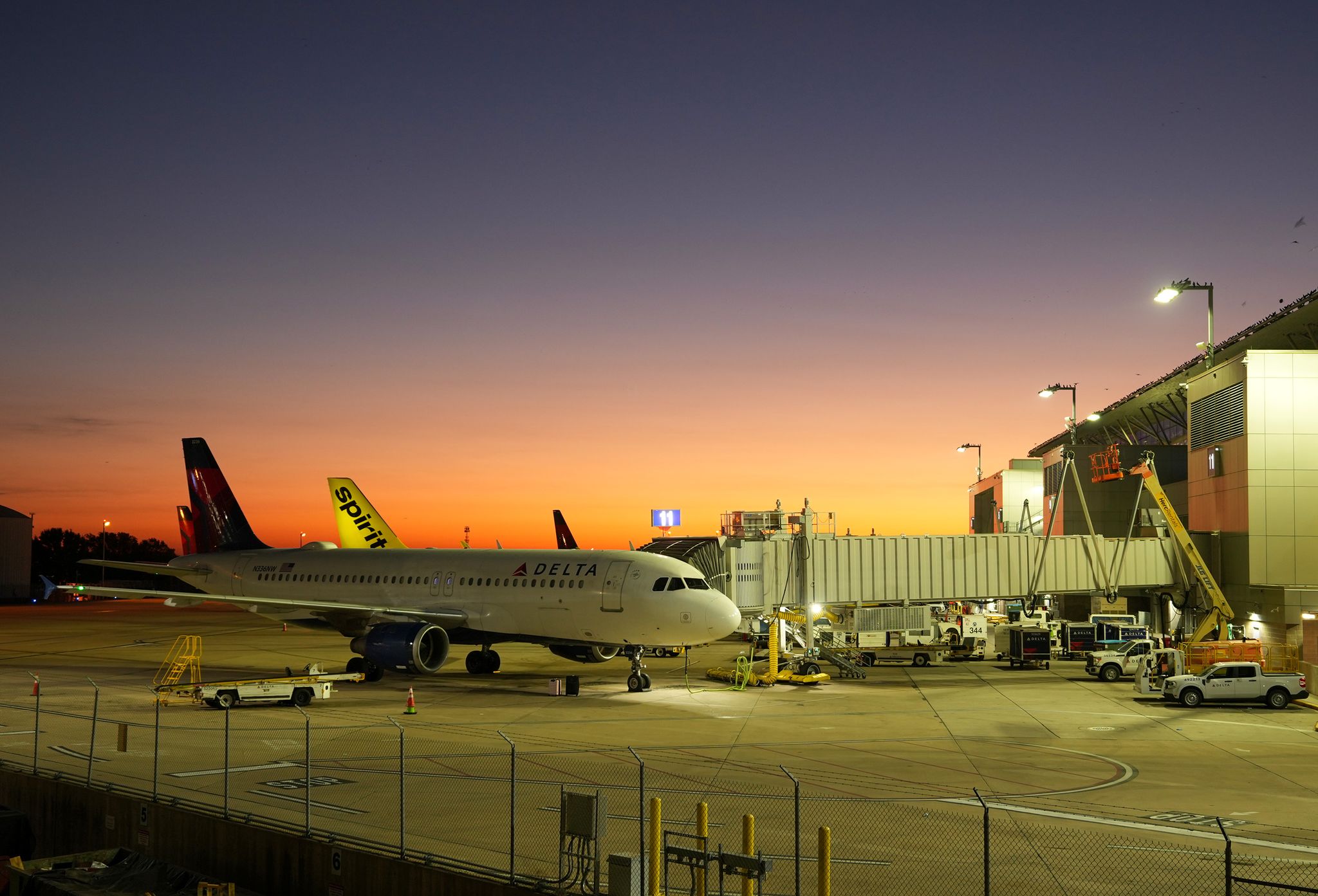
Upward of 35,000 passengers were expected to depart Austin‑Bergstrom on Friday and more than 30,000 on Saturday (≈50% above a typical Saturday), producing extended TSA lines as officers work without pay amid the DHS partial shutdown that began Feb. 14 and has prompted over 300 TSA departures. Airport officials warned of repeated peak days through late March and early April, urged passengers to arrive 2.5 hours early for domestic/3 hours for international flights, and opened Checkpoint 4 (four lanes) to help relieve congestion. The situation is an operational negative for traveler experience and could strain regional airline operations/schedules but is unlikely to move broader markets.
The immediate throughput shock from an underpaid/unavailable frontline workforce is a classic capacity-friction event: schedules are sticky while processing capacity is variable, so delays cascade nonlinearly across a point-to-point network. Expect a concentrated increase in re-accommodation costs and crew/aircraft inefficiency for carriers with high leisure exposure in Texas (early-morning peaks), materially compressing near-term unit revenue for those carriers for 2–6 weeks even if base demand remains intact.
Adjacent beneficiaries and losers diverge by revenue type. Airports and concessionaires capture transient upside from stranded or delayed passengers (higher F&B and parking yields) but incur extra staffing and shuttle costs; rental car firms see higher short-term utilization and yield but longer teardown/return friction that increases fleet idle time and cleaning costs. Separately, a longer shutdown accelerates capital spending narratives for automated screening and scanner vendors — a 6–24 month procurement tail could be re-priced into defense/security names if appropriations shift toward modernization.
Timing and catalysts are binary and fast: a stopgap funding bill or emergency pay fix normalizes flow within 48–72 hours; absence of that turns a localized operations problem into a multi-week revenue hit and reputational loss that lowers forward bookings for leisure-heavy carriers. Monitor intraday OTP trends, early-morning load factors, and TSA sick-call rates as immediate indicators; watch House/Senate appropriations language for explicit screening equipment line items as a 3–12 month catalyst.
The consensus frames this as a short-lived PR problem; the market should instead treat it as a transient operational shock with differentiated winners (automation vendors, resilient hub carriers) and losers (point-to-point LCCs tied to affected airports). That makes short-dated volatility and paired trades more attractive than broad, long-duration sector bets.
AI-powered research, real-time alerts, and portfolio analytics for institutional investors.
Request DemoOverall Sentiment
mildly negative
Sentiment Score
-0.25
