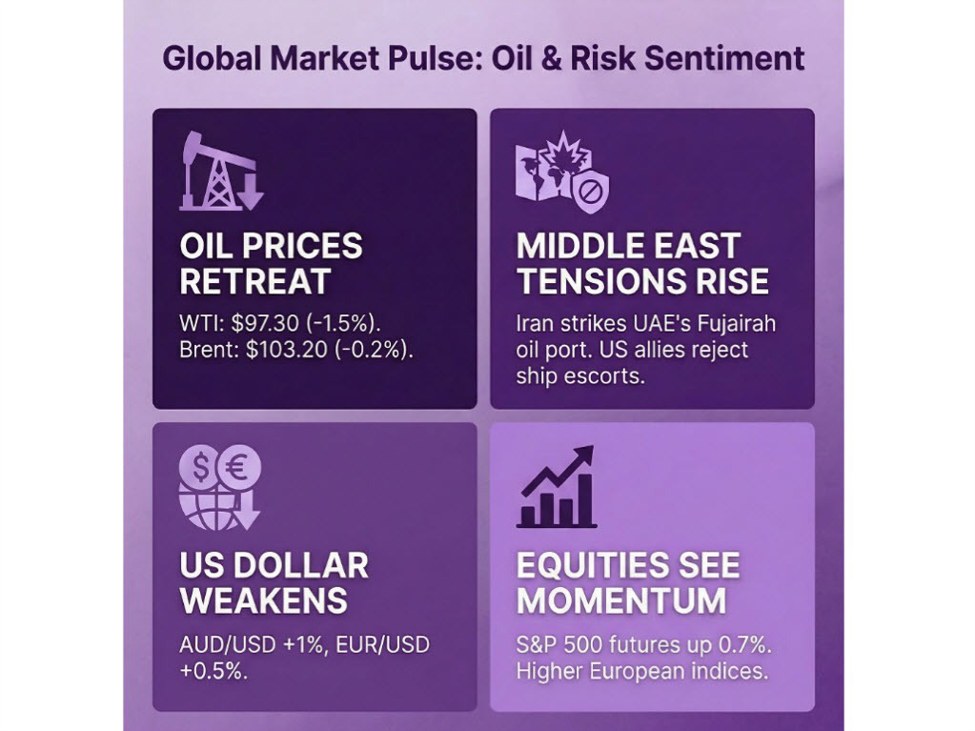
WTI fell 1.5% to $97.30 and Brent eased to $103.20 as markets paused; S&P 500 futures are up ~0.7% while US 10-year yields slipped 3bps to 4.25%. The dollar weakened (EUR/USD 1.1475, +0.5%; USD/JPY ~159.20) and Bitcoin rallied ~2.5% to $73,630, with gold marginally lower at $5,017. Geopolitical risk remains elevated after Trump's request for allies on the Strait of Hormuz was rebuffed—risk-on moves may be short-lived and a single negative headline could reprice energy and risk assets sharply, so monitor oil flows and headline risk closely.
The market’s “breather” is a classic short-term risk repricing: headline sensitivity falls and carry-driven, risk-on flows resume, but the structural frictions created by targeted attacks (ports, loading ops) persist and will ratchet real costs even if nominal crude prices stabilize. Expect persistent risk premia in marine insurance and time-charter markets — these are supply-chain wedges that do not unwind on the same cadence as spot prices because they depend on routing, war-risk premiums, and crew/port access, effectively raising delivered crude costs to consuming regions for weeks to months.
Currency and rate dynamics create an asymmetric policy cliff: FX intervention or quasi-intervention by a major central bank can compress realised volatility for the pair for days, but it does not remove underlying flows from energy and risk-hedging activity which will push real rates and term premia in either direction as inflation expectations adjust. That makes short-dated event trades and option structures preferable to directional cash exposure; meanwhile multi-week scenarios where supply disruption persists would push company-level cashflows (midstream, refiners, tanker owners) sharply out of consensus.
The second-order winners are firms that capture freight and margin dislocations (tanker owners, physical traders with storage optionality, specialty insurers); losers are refiners with tight feedstock logistics and industries levered to transportation cost (chemicals, integrated manufacturers dependent on Mideast feedstock). The key catalyst ladder runs from isolated port harassment (days) to sustained chokepoint disruption (weeks) to geopolitical escalation that triggers broader sanctions/strategic naval deployments (months), and portfolio positioning should be staged accordingly with strict time decay management on option exposure.
AI-powered research, real-time alerts, and portfolio analytics for institutional investors.
Request DemoOverall Sentiment
mixed
Sentiment Score
0.05
