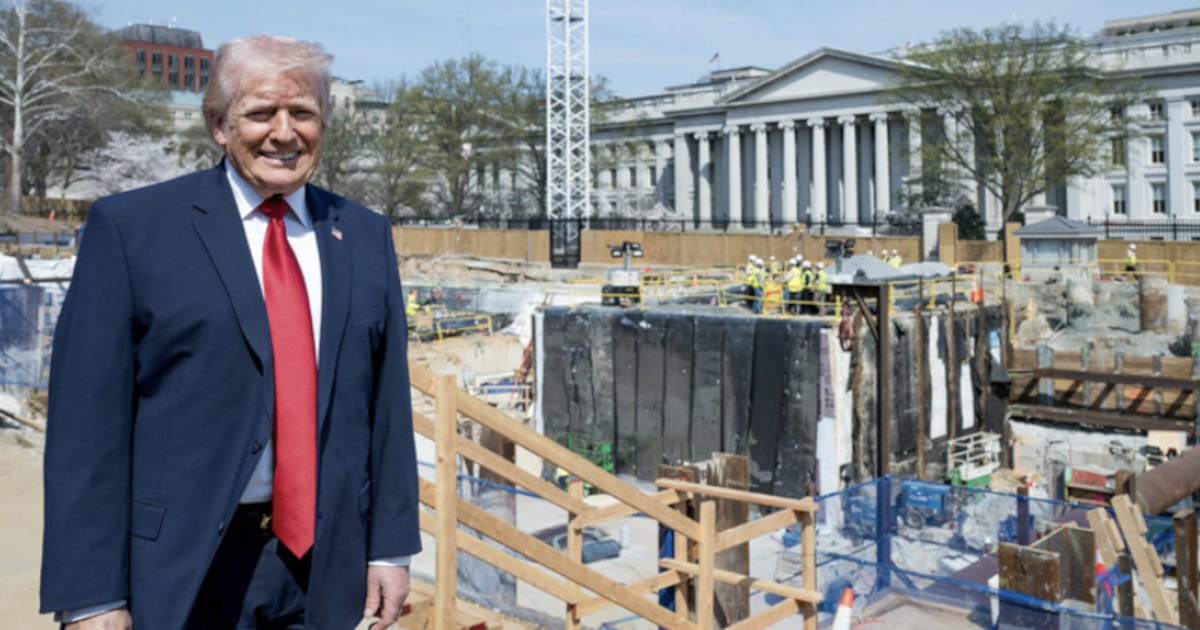
A federal appeals court temporarily allowed President Trump to resume above-ground construction on the $400 million, 90,000-square-foot White House ballroom project after a district court had halted it. The National Trust for Historic Preservation is suing to block the build, arguing Trump lacked required approvals, and a full appellate hearing is set for June 5. The ruling is procedural and politically charged, but it is unlikely to have direct market impact.
The immediate market read is not on the ballroom itself but on process risk: the court’s willingness to reinstate construction signals that federal agencies and heritage plaintiffs may have a high bar to stop executive-backed projects once physical work is underway. That lowers near-term legal friction for politically connected builders and engineering contractors, while raising the odds of a longer, more expensive litigation path rather than a clean injunction. The second-order effect is that “pause risk” gets repriced lower for any contractor with Washington exposure, especially if the administration treats this as a test case for accelerating discretionary federal buildouts.
The more interesting angle is that the project’s economics are likely less sensitive to the headline budget than to schedule certainty. Every week of delay on a politically sanctioned project can create meaningful cost overruns via labor resequencing, procurement resets, and change-order leverage for subs; if the stay holds, those costs are deferred, not eliminated. That makes beneficiaries less the obvious marquee construction names and more the specialty subcontractors, suppliers of interior systems, security infrastructure, and luxury finishes that can absorb fast-tracked demand without needing a long permitting chain.
For markets, this is a governance signal, not an earnings event: it suggests a friendlier operating environment for firms tied to federal real estate, defense-adjacent facilities, and politically exposed development, while preserving litigation overhang. The contrarian miss is that the court fight may ultimately widen, not narrow, the moat around such projects—an eventual merits loss would not just stop this build but could chill similar initiatives for quarters. So the setup is asymmetric: near-term relief for builders, but a medium-term headline-risk premium that could snap back if the June hearing turns adverse or if additional plaintiffs seek broader remedies.
AI-powered research, real-time alerts, and portfolio analytics for institutional investors.
Request TrialOverall Sentiment
neutral
Sentiment Score
-0.05
