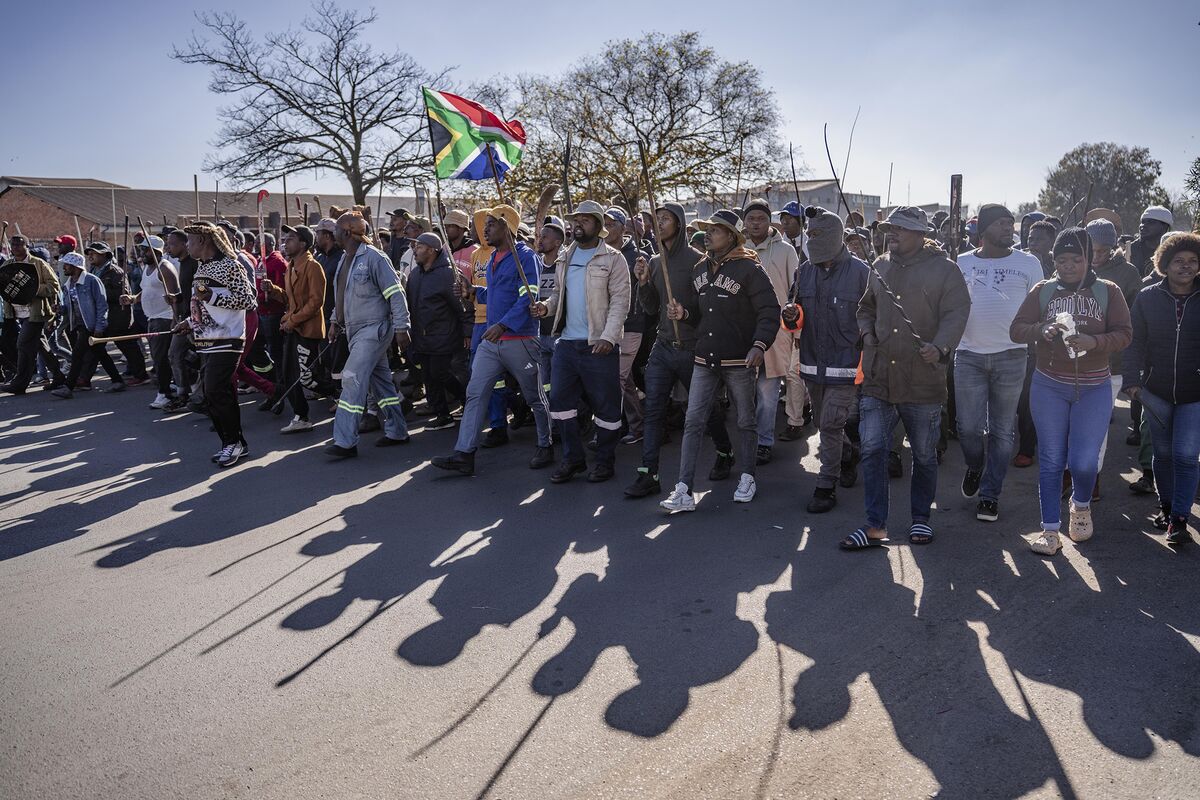
South African businesses are pledging drone and helicopter support for police ahead of an expected anti-immigrant mobilization on June 30, highlighting rising domestic security tensions. The response is being coordinated through Business Against Crime South Africa’s E2-Plus program. The article is largely factual and localized, with limited direct market impact beyond security and social-stability concerns.
The immediate market impact is not in the security providers themselves but in the cost of doing business for consumer-facing and logistics-heavy operators. Heightened policing around a politically charged migrant deadline raises the odds of localized transport disruption, retail footfall weakness, and discretionary spend softness in affected metros for days to a few weeks. The second-order winner is likely the private security and surveillance ecosystem: even if this specific response is temporary, it reinforces a procurement pattern where public agencies increasingly lean on private air/monitoring capacity when social tension spikes.
The more important read-through is political risk premium expansion, not a one-off protest event. If the mobilization is contained cleanly, the trade is mean-reverting within 1-2 weeks; if there are viral images of unrest or any spillover into highways, ports, or informal trade corridors, the market can quickly discount broader labor and policy instability for months. That matters for South African corporates with high domestic revenue exposure, especially banks, retailers, telecoms, and transports, which tend to re-rate lower on even modest increases in perceived civil disorder.
The contrarian point is that visible preventative security spending may actually reduce tail risk versus a full-blown disorder scenario, limiting macro spillover. In other words, the headline sounds worse than the expected realized damage if state-private coordination is effective. The larger medium-term issue is that repeated reliance on quasi-private security capacity can become a structural signal of weak state control, which is negative for foreign direct investment and long-duration local assets even when the immediate event passes.
AI-powered research, real-time alerts, and portfolio analytics for institutional investors.
Overall Sentiment
mildly negative
Sentiment Score
-0.15
