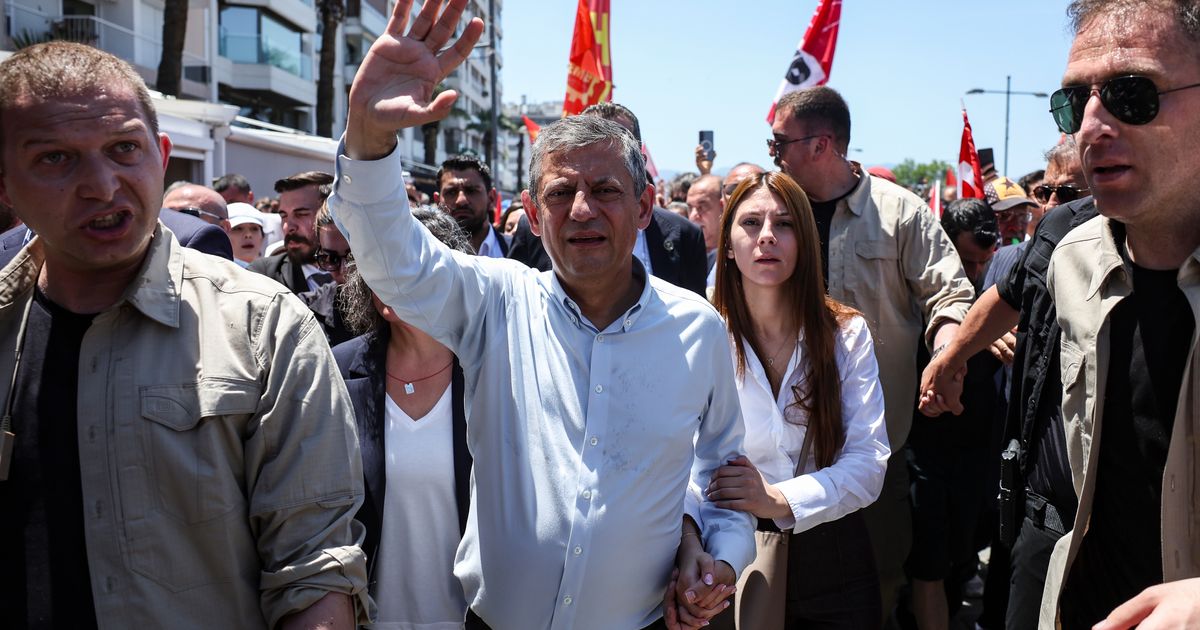
Turkey's main opposition CHP is facing a court-ordered leadership reversal, with Ozgur Ozel removed and replaced by former leader Kemal Kilicdaroglu after a May 21 appeals ruling overturned the party's 2023 congress vote. The dispute has triggered mass protests in Ankara and comes amid broader legal pressure on CHP-run municipalities, with hundreds of officials and members detained. While the article is politically focused, the escalation adds to Turkey's domestic political risk and could affect investor sentiment toward the country.
This is less a one-off legal event than a regime-risk escalation for Turkish risk premia. When opposition leadership can be re-litigated by courts, investors have to price a higher probability of policy continuity, weaker institutional checks, and a faster drift toward capital controls or administrative pressure if market stress builds. The immediate market read is not about who leads the CHP; it is about whether the state has expanded the toolkit it can use against any organized alternative, which tends to keep the lira, local rates, and domestic cyclicals permanently “one headline away” from a repricing.
Second-order, the biggest beneficiaries are not obvious political proxies but firms with hard-currency revenue, offshore cash flow, or low domestic funding dependence. Banks and consumer-facing names are the most exposed because they sit directly in the transmission channel: policy uncertainty can tighten funding, raise deposit dollarization, and compress credit growth before any broad macro damage shows up. The timing matters: the next few weeks are a volatility trade, but the next 3-9 months is where investors will test whether early elections, additional prosecutions, or another party-internal intervention becomes the new baseline.
The contrarian view is that markets may already be partially immunized to Turkish political noise, so the first knee-jerk selloff in local assets can fade if there is no follow-through on enforcement. If opposition fragmentation intensifies between court-removed leadership and rival factional gatherings, the government may actually face a less coherent challenger, which could reduce near-term electoral risk even as governance quality worsens. That creates a subtle asymmetry: headline risk is elevated, but the investable shock only persists if it translates into constraints on capital movement, bank regulation, or an early-election schedule.
AI-powered research, real-time alerts, and portfolio analytics for institutional investors.
Request TrialOverall Sentiment
moderately negative
Sentiment Score
-0.35
For non-Turkey investors, the broader EM implication is a modest risk-off tailwind rather than a full contagion event. The cleaner trade is to fade domestic Turkey exposure on rallies and own optionality on volatility rather than make a large directional macro bet immediately, because policy response can be delayed but tends to be decisive once FX stress appears.
