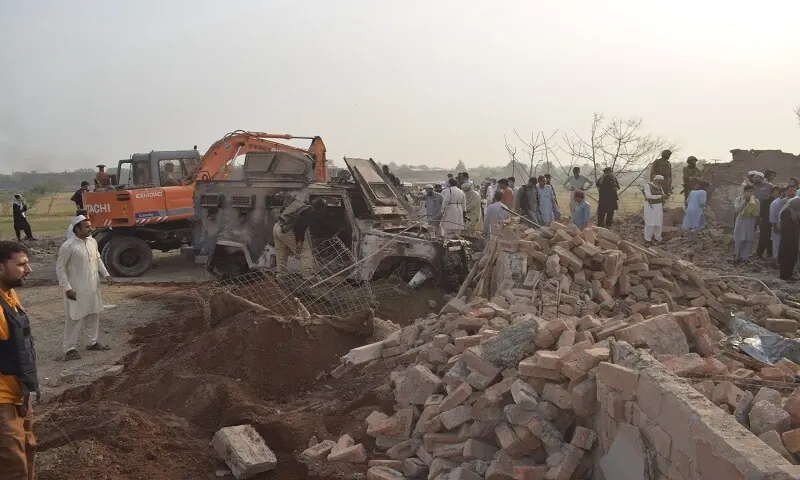
At least 15 police personnel were killed and 3 injured in a suicide attack on the Fateh Khel police post in Bannu district, Khyber Pakhtunkhwa. The assault used an explosives-laden vehicle, heavy gunfire, multiple blasts, and quadcopters, completely destroying the post and an armored vehicle while damaging nearby buildings. The incident underscores escalating militant violence in the region and prompted emergency hospital measures, a police operation, and tightened security across Bannu.
This is less a one-off security incident than evidence of a widening state-capacity gap in a strategically sensitive interior corridor. The second-order effect is a higher probability of recurring disruptions to local commerce, trucking, and public service delivery, which tends to suppress near-term provincial investment rather than create a broad national risk-off event. The market takeaway is that the impact is mostly local and short-dated, but repeated attacks can gradually raise the discount rate on Pakistan risk assets through weaker confidence in rule-of-law and logistics reliability.
The immediate beneficiaries are any security-adjacent contractors, private protection providers, and crisis-response suppliers with exposure to elevated internal-security budgets; the losers are domestic transport, retail distribution, and construction activity in the affected region. If violence persists over the next 1-3 months, expect a tighter checkpoint regime that slows intercity movement and raises fuel, insurance, and working-capital costs for local operators. That can also widen the gap between Islamabad/Karachi-linked activity and peripheral districts, reinforcing capital concentration in safer urban centers.
The larger tail risk is not the event itself but escalation into a copycat cycle: each high-casualty attack increases the odds of heavier security operations, which can further disrupt the economy and provoke retaliatory violence. The key reversal catalyst would be a visible, sustained drop in attack frequency over several weeks plus credible political signaling that security resources are being reallocated effectively. Without that, the base case is continued episodic violence with negative but localized economic drag rather than systemic spillover.
Contrarian view: the market may overestimate the broader macro shock from incidents like this while underpricing the cumulative medium-term impairment to provincial growth and local credit quality. For diversified investors, the better expression is not a blanket country short, but selective downside in names tied to domestic mobility, consumer footfall, and SME lending if the security trend worsens.
AI-powered research, real-time alerts, and portfolio analytics for institutional investors.
Request DemoOverall Sentiment
extremely negative
Sentiment Score
-0.95
