
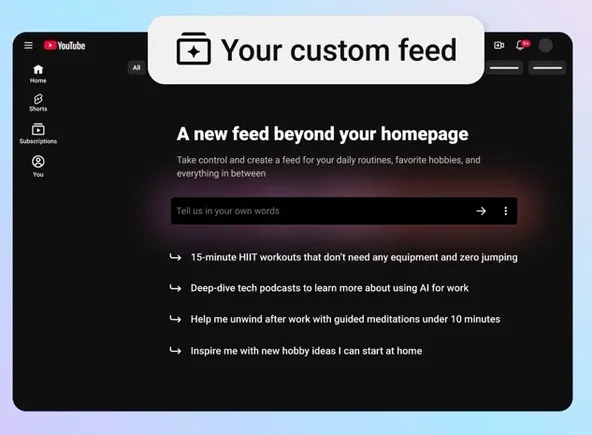
YouTube is rolling out a new conversational custom feed feature that lets users generate and pin personalized content feeds based on text prompts. The update is currently available to signed-in U.S. users on the mobile app or desktop in English, with search and watch history required. The change should improve content discovery and engagement, but the near-term market impact is likely limited.
This is a small feature launch with potentially outsized strategic value because it attacks discovery friction at the exact point where generative AI is becoming the default interface layer. For GOOGL, the upside is not immediate direct monetization so much as higher session quality: better intent capture should lift watch time, search depth, and creator/content match quality, which feeds the recommendation loop and improves ad inventory persistence. The second-order benefit is defensive: if users increasingly expect prompt-based curation inside YouTube, it raises the switching cost to alternative video apps and standalone AI discovery tools.
The main medium-term risk is that conversational feed generation can degrade if relevance quality is inconsistent, creating a “promised personalization” problem that frustrates users faster than traditional recommendations because the intent is explicit. That matters over a months-long horizon: if early cohorts don’t see a measurable engagement lift, the feature becomes UI garnish rather than a retention lever. It also increases dependence on search/watch history being enabled, which could cap adoption among privacy-sensitive users and temper the addressable uplift.
Consensus likely underestimates how strategically important YouTube is as a training ground for Google’s consumer AI interfaces. If this works, it provides a template for prompt-driven personalization across other surfaces, but the market may still be pricing GOOGL as if AI is primarily a cost story rather than a habit-forming distribution story. The contrarian angle is that the bigger risk is not cannibalization but under-delivery: if the experience feels gimmicky, Google loses a chance to widen the moat around its highest-retention consumer property.
AI-powered research, real-time alerts, and portfolio analytics for institutional investors.
Request TrialOverall Sentiment
mildly positive
Sentiment Score
0.20
Ticker Sentiment
