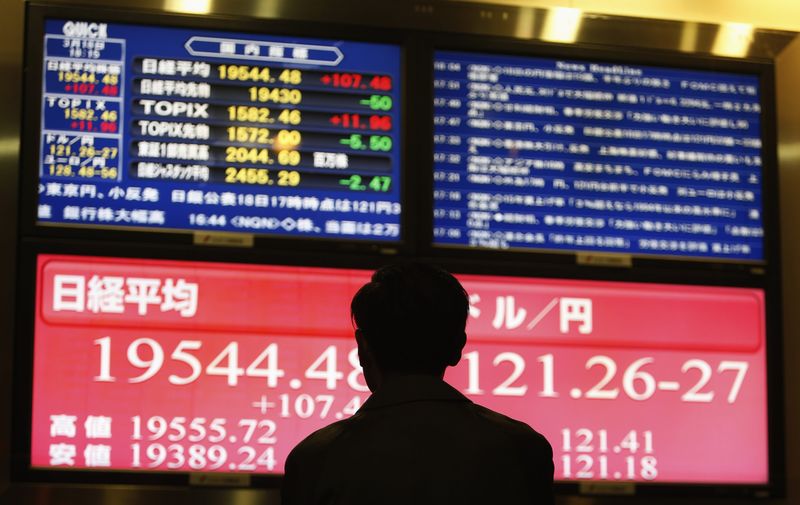
Asian markets extended gains, with Japan’s Nikkei 225 up 2.6% to a record 59,624 and South Korea’s KOSPI rising more than 2%, as investors reacted to record highs on Wall Street and easing U.S.-Iran tensions. China’s Q1 GDP grew 5.0% year-on-year, above the 4.8% forecast, while industrial production rose 5.7% and retail sales increased 1.7%, supporting regional sentiment despite mixed domestic demand data. Australia’s unemployment rate held at 4.3%, but the ASX 200 slipped 0.2%.
TSMC sits at the center of a rare alignment: improving AI-driven demand, an equity market willing to pay up for secular growth, and a macro backdrop that is temporarily suppressing the usual geopolitical discount on semiconductor supply chains. The immediate read-through is not just better wafer demand, but higher confidence that hyperscaler capex remains intact into the next quarter, which tends to support the entire leading-edge equipment stack with a lag of 1-2 reporting cycles. In risk-on tapes like this, TSM often acts as a proxy for the durability of the AI buildout rather than a single-earnings story.
The more interesting second-order effect is on relative performance inside semis. If Taiwan’s foundry remains insulated from near-term disruption, the market should continue to reward the names with the highest exposure to advanced nodes and packaging bottlenecks, while legacy cyclicals lag as investors rotate toward structural growth. That creates a favorable backdrop for a long TSM / short broad semiconductor beta expression: the company’s earnings quality is improving, but the index still embeds a lot of cyclicality that is increasingly less relevant to the AI capex trade.
The geopolitical overhang is the main tail risk, but it likely operates first through sentiment and shipping insurance before it shows up in physical supply. A true Strait of Hormuz shock would be inflationary and could compress multiples across tech even if fundamentals hold, yet the market is currently discounting diplomacy, not escalation. That means the near-term risk/reward is asymmetric: upside can persist on incremental good news, while downside likely requires a much more severe escalation than the tape is pricing.
Contrarian view: the consensus may be underestimating how much of the AI premium is already embedded in the stock and overestimating how quickly geopolitical calm can translate into broader Taiwan semiconductor re-rating. If China data remains mixed, the market may eventually separate AI beneficiaries from the rest of Asia tech, which argues for being selective rather than mechanically buying the whole complex. The better trade is to own the highest-quality node exposure and fade weaker cyclicals that are riding the same sentiment wave.
AI-powered research, real-time alerts, and portfolio analytics for institutional investors.
Request DemoOverall Sentiment
mildly positive
Sentiment Score
0.25
Ticker Sentiment
