







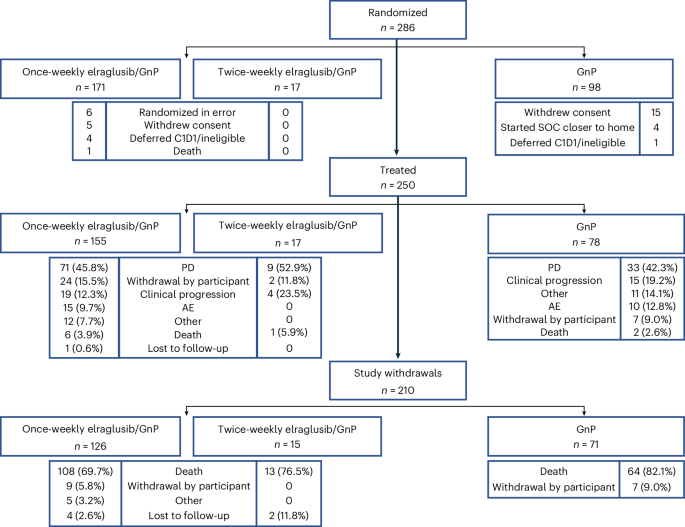
Elraglusib plus gemcitabine/nab-paclitaxel improved median overall survival by 2.9 months in previously untreated metastatic pancreatic cancer, with OS rising to 10.1 months versus 7.2 months for standard GnP and the 1-year survival rate nearly doubling to 44.1% versus 22.3%. The phase 2 trial also showed manageable safety, with neutropenia and visual impairment the key adverse events, and a phase 3 study is being planned. The result is clinically meaningful for the drug developer and could support a higher valuation if confirmed in a larger trial.
ACTU is the only direct equity winner here, but the more interesting implication is that this de-risks the entire GSK-3 / immunomodulation thesis in a tumor type where “survival without PFS” is usually a red flag. If the phase 3 is directionally positive, ACTU can re-rate from a binary microcap biotech into a platform story: the market will start capitalizing not just one pancreatic readout, but optionality in FOLFIRINOX/NALIRIFOX and checkpoint combinations. That also creates second-order pressure on companies selling “incremental benefit” in pancreatic cancer without a cleaner mechanistic edge, especially if oncologists begin viewing elraglusib as a backbone enhancer rather than a niche add-on.
The key nuance is that the data support a biology-driven response pattern, not just a cytotoxic boost. That matters because it broadens the addressable commercial logic: if benefit is concentrated in immune-permissive or inflammatory subgroups, ACTU could end up with a patient-selection strategy that improves phase 3 odds and improves economic value per treated patient. Conversely, the hematologic and visual AEs are not trivial — they suggest the drug may be effective precisely where marrow reserve is already strained, which could cap penetration into the frailest first-line population and keep uptake tied to centers comfortable managing intensified supportive care.
Near term, the stock should trade on confirmation risk rather than sales math. The main tail risk is that the phase 3 loses the OS benefit, because the current signal still rests on a single randomized phase 2 in a heterogeneous population with open-label dynamics; if the effect size compresses even modestly, the equity could give back most of the move. The contrarian view is that the Street may be underestimating how much of this is already embedded in sentiment: the first leg up is justified, but the next leg likely requires either a stronger biomarker-enriched story or a clean phase 3 design with enough power to shut down the “good phase 2, bad phase 3” narrative.
AI-powered research, real-time alerts, and portfolio analytics for institutional investors.
Request TrialOverall Sentiment
strongly positive
Sentiment Score
0.78
Ticker Sentiment
