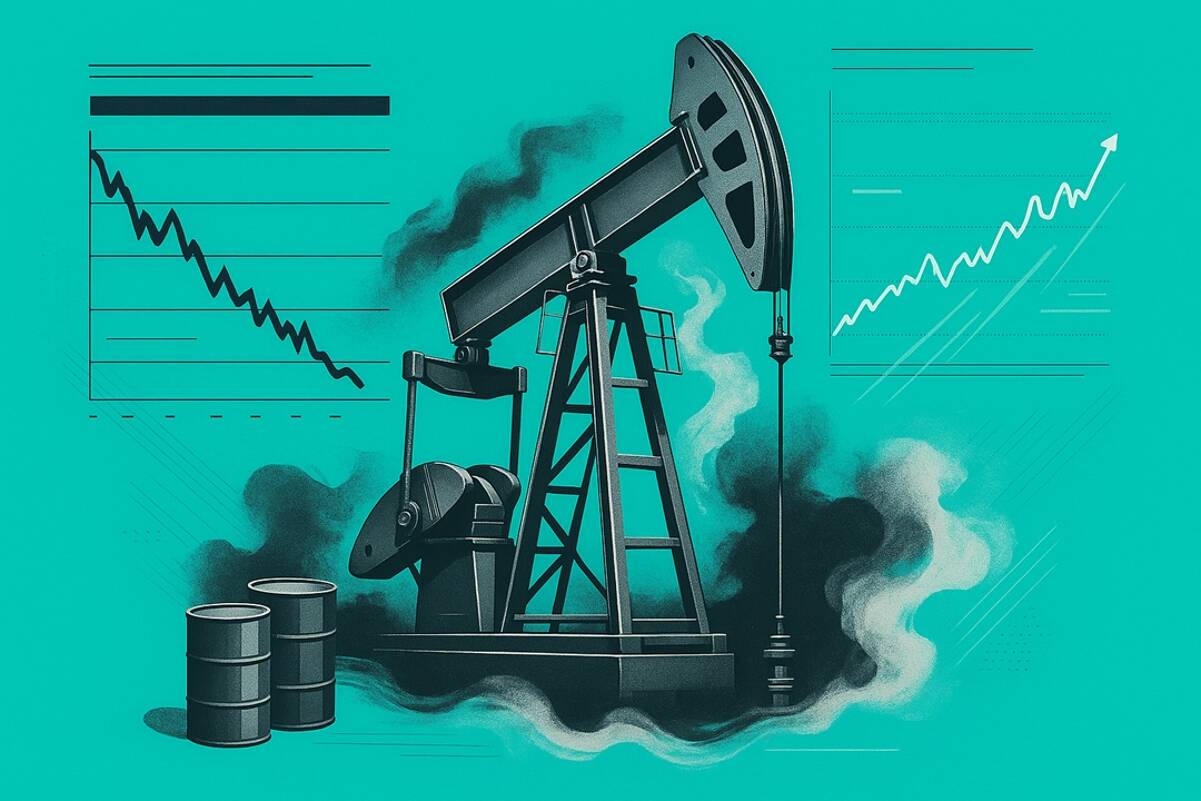
WTI crude is under pressure after falling below the $70.50-$71.50 support zone and is trying to settle below $69.00, with the next downside target at $66.50-$67.00. Brent is also weakening, trading below $72.00-$72.50 support and eyeing $67.00-$67.50, as traders expect Strait of Hormuz flows to remain intact despite renewed Iran-linked tensions. Natural gas is attempting to hold above $3.25-$3.30, with upside to $3.35-$3.60 if it clears resistance, while downside support sits at $3.12 and then $3.00-$3.05.
The cleanest read-through is not “higher geopolitical risk,” but a market that is increasingly pricing logistics normalization faster than headline risk. That creates a near-term winner set in refiners, airlines, and petrochemical consumers if crude continues to bleed lower; the second-order effect is margin relief for freight-heavy cyclicals, which often lags the first move in oil by 2-6 weeks. Gulf producers are the obvious losers, but the more interesting loser is any asset class that was using a Strait-of-Hormuz risk premium as a valuation crutch — once that premium compresses, it is hard to re-inflate without a genuine supply disruption.
The technical setup matters because it suggests systematic selling can persist even if headlines stay noisy. Oversold RSI in a strong trend is not a floor; it often signals that trend-followers and CTAs still have room to add, especially when calendar-roll mechanics and weak bullish catalysts line up. That means the downside path can extend more than fundamentals alone would justify over the next several sessions, with $66-$67 acting as a magnet if $69 fails decisively.
The contrarian risk is that the market is underpricing the probability of a policy response rather than an incident response. If shipping fees, enforcement actions, or any credible disruption to insurance/route economics emerges, crude can gap higher quickly because the physical market is tight enough to reprice on perceived transit friction, not just actual lost barrels. In that scenario, the current bearish positioning becomes vulnerable to a fast 5-8% squeeze in one to two days.
Natural gas is a separate tape: the key is whether storage/contract-roll flows can overpower technical resistance. A break above the upper band would likely trigger momentum buying from funds that have been underweight gas through the summer shoulder season, but failure there should keep it range-bound and punish longs that are chasing a late-roll bounce rather than a genuine demand shock.
AI-powered research, real-time alerts, and portfolio analytics for institutional investors.
Request DemoOverall Sentiment
moderately negative
Sentiment Score
-0.45
