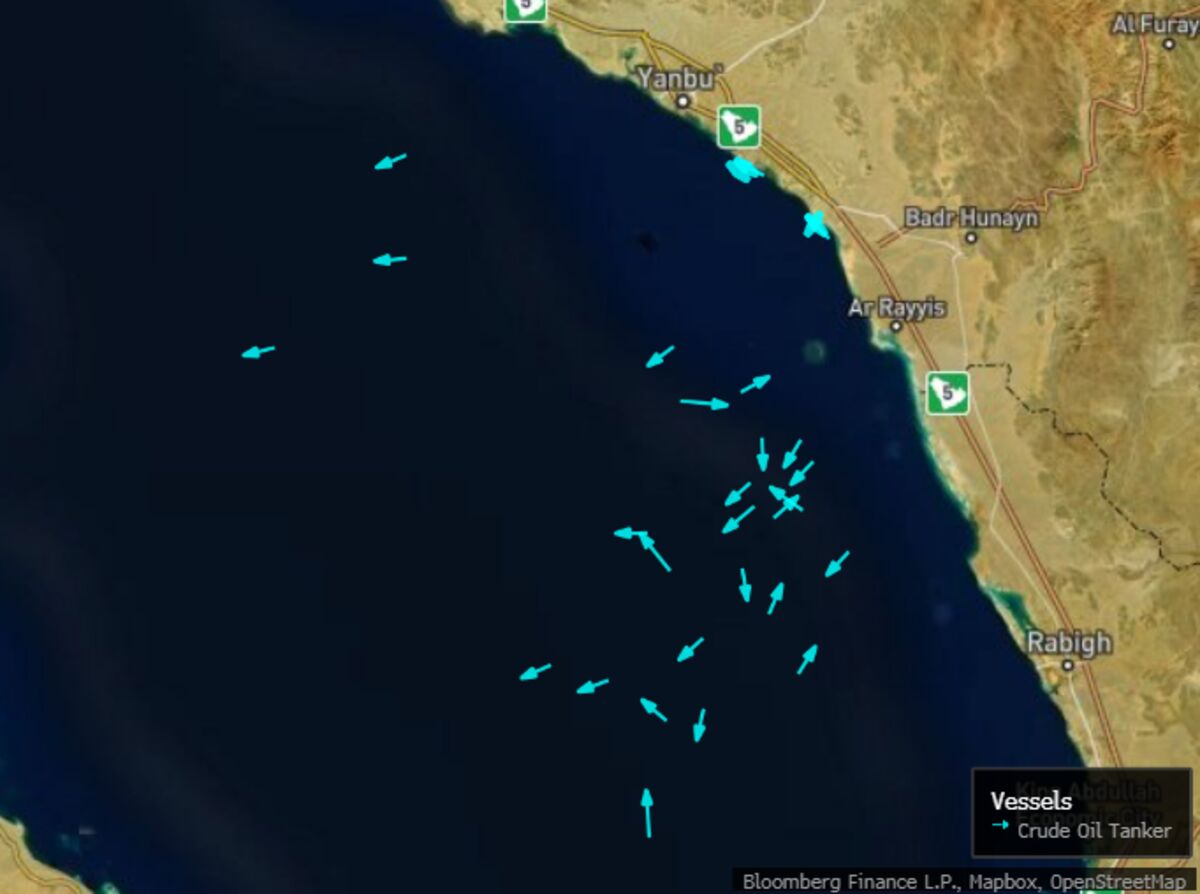
There were at least 27 crude carriers anchored near Yanbu's two crude export facilities on Monday, up from 11 on Friday (+145%), as Saudi Arabia accelerates rerouting oil exports to bypass the Strait of Hormuz after the waterway was effectively closed. The rapid buildup risks creating bottlenecks at Red Sea export terminals, tightening tanker availability and potentially increasing freight rates and near-term oil price volatility.
Rerouting crude away from Hormuz is a pure tonne-mile shock: each barrel now ties up more days of seaborne transit and requires additional ballast voyages, which amplifies demand for VLCC/Suezmax days-charter capacity beyond the headline volume shift. That mechanical increase in usable tonnage (and the transient use of vessels as floating storage) can lift spot/TC rates quickly while leaving longer-term time-charter markets and newbuild deliveries largely unresponsive in the short run, creating a lumpy supply/demand squeeze over weeks to a few months.
Winners are the most spot-exposed crude tanker owners, brokers and war-risk insurers — the last benefits from higher premia that are sticky until political risk recedes. Losers include Asian refiners that rely on timely Middle East supply (margins compress as freight is added to delivered cost) and regional transshipment hubs whose inventory/berth capacity becomes the new constraint; second-order effects include container lines facing schedule unreliability and higher fuel/insurance pass-throughs to trade lanes.
Tail risks and catalysts are binary and time-staggered: a Houthi ceasefire or robust naval escort program can normalize transits in days–weeks and collapse the freight squeeze, while progressive Saudi investment in pipeline/terminal capacity or a multi-month convoy cadence would extend higher-rate regimes into quarters. The consensus underprices operational frictions — port berthing rates, pilot availability and local storage capacity — which means freight can oscillate violently even if overall export volumes remain unchanged; watch Baltic Dirty Tanker Index moves, war-risk premium levels and ship-to-ship (STS) activity for real-time signal confirmation.
AI-powered research, real-time alerts, and portfolio analytics for institutional investors.
Overall Sentiment
neutral
Sentiment Score
0.00
