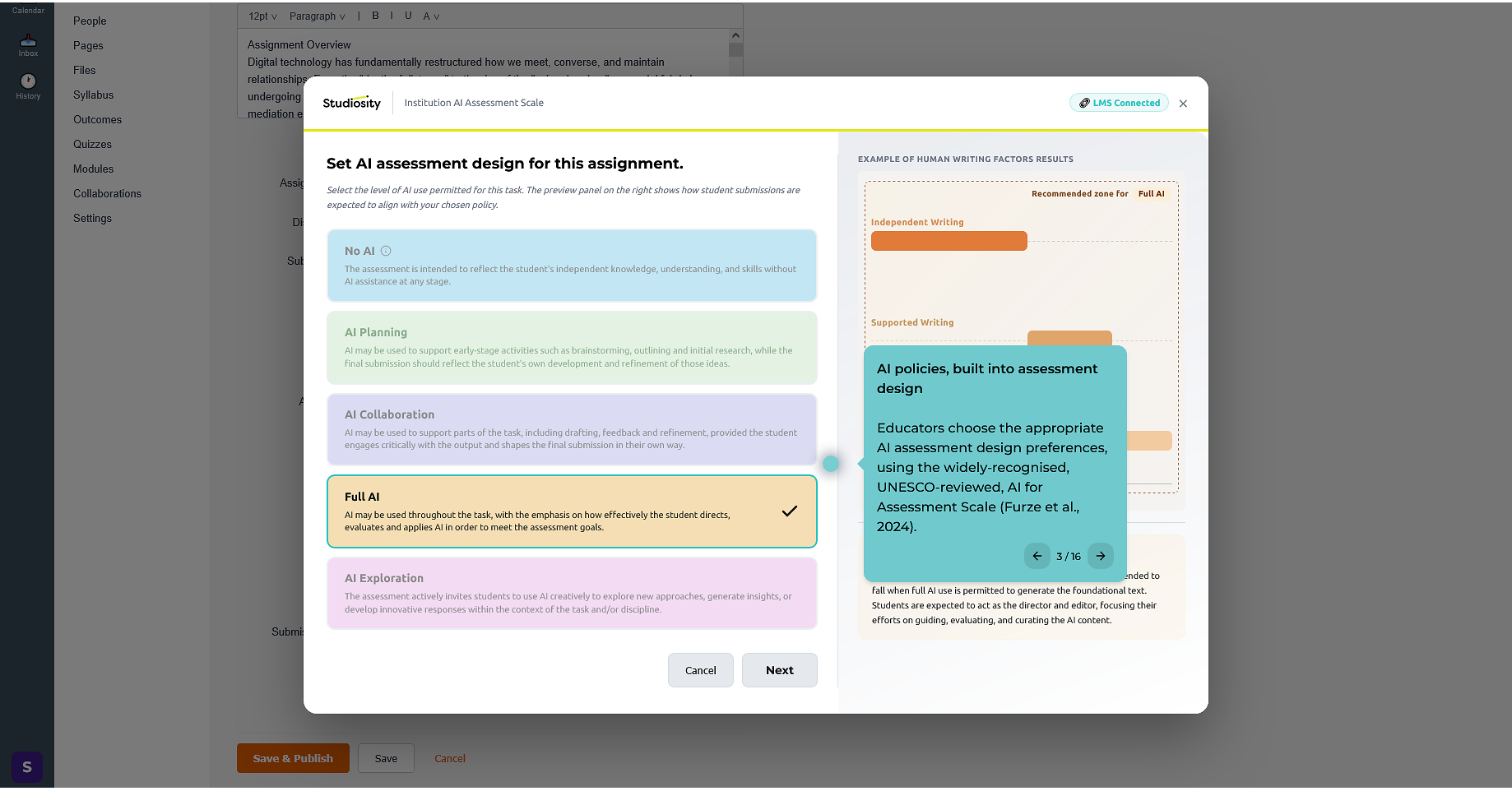
Studiosity announced a formal agreement to integrate the Artificial Intelligence Assessment Scale (AIAS) into its assessment platform used by universities in 15 countries. The 5-level AIAS is embedded into LMS task setup to enable “zero cognitive offload” assessment design, with authorship self-validation and auditable evidence for educators while reducing AI-policy-to-assessment workload. The news is positive for the education-AI integrity workflow, but it is unlikely to be material for broader markets.
This is more important as a budgeting signal than as a standalone revenue event: universities are moving from ex-post policing of AI use toward ex-ante assessment design embedded in the core workflow. That tends to favor LMS and workflow incumbents that can sell compliance, validation, and faculty-efficiency modules as attach revenue, while point solutions that rely on catching misconduct face pricing pressure and slower renewal cycles.
The second-order winner is not the AI layer itself but the systems of record around it. If institutions decide they need auditable authorship, vendors with deep LMS distribution can convert policy anxiety into sticky SaaS expansion; if not, the spend stays fragmented in staff time and consulting. The likely losers are standalone detection/proctoring businesses and consumer homework-help models, because the market is implicitly saying the institutional response is to redesign tasks, not to chase ever-better detection.
Timing matters: near-term equity impact is probably negligible because procurement cycles are long and this reads like a framework endorsement, not a measurable contract win. Over 1-3 quarters, watch for attach-rate commentary from education software vendors and any evidence that assessment-assurance modules are being pulled into enterprise renewals. The thesis fails if schools treat this as policy theater and keep using internal workarounds instead of paying for software, or if faculty resistance makes the workflow too cumbersome to scale.
Contrarian view: the consensus may be overestimating how fast universities operationalize AI governance. Most institutions have mandate risk but limited IT bandwidth, so adoption could stall at pilot stage while vendors compete on messaging rather than budgets. That makes the upside real but slower-moving than the press release implies, which argues for a selective, not broad, edtech expression.
AI-powered research, real-time alerts, and portfolio analytics for institutional investors.
Request DemoOverall Sentiment
mildly positive
Sentiment Score
0.18
