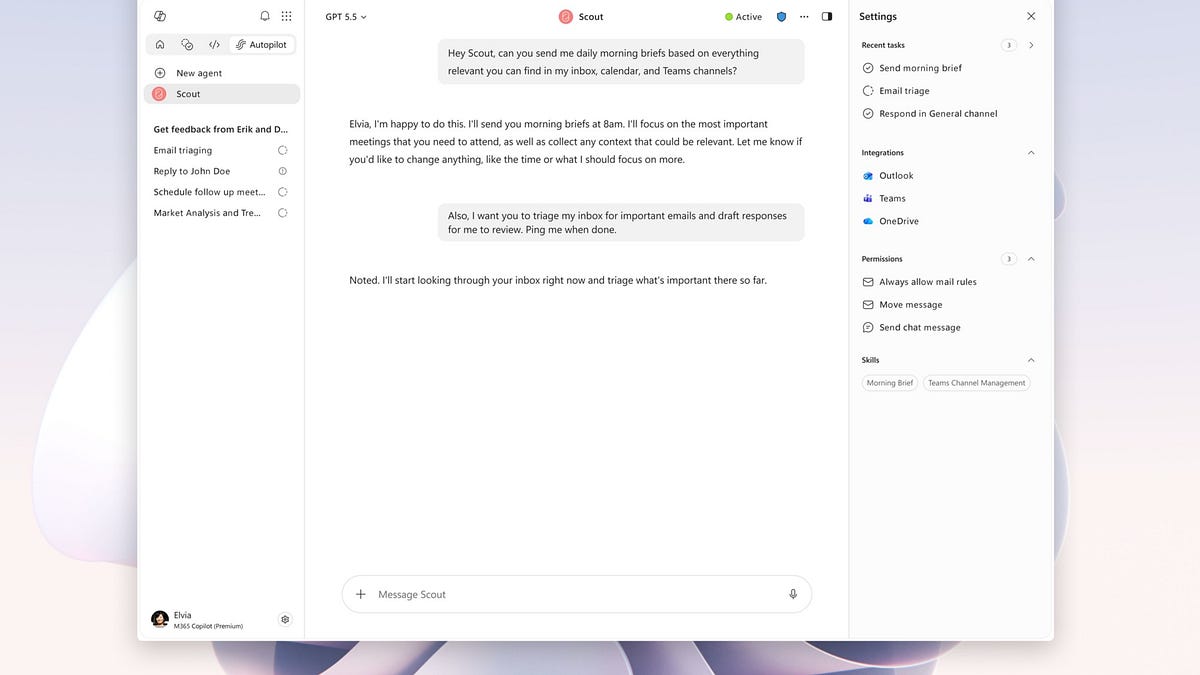
Microsoft is building a unified AI super app that combines Copilot chat, coding, the Cowork task assistant, and a new agentic layer called Autopilot, with a previously unreported proactive agent named Scout. The article suggests a meaningful product consolidation and expansion of Microsoft’s AI strategy, but it provides no financial metrics or launch timing. Market impact is likely limited unless Microsoft confirms commercialization details.
Microsoft is signaling that it wants to re-aggregate the AI workflow before rivals can commoditize the interface. The important second-order effect is not the chat layer itself, but the bundling of task execution, coding, and proactive agents into a single habit-forming surface; that raises switching costs and increases the odds that enterprise users default to Microsoft for discovery, orchestration, and security governance. If execution is credible, this is a modest positive for MSFT's platform monetization because it supports higher attach rates to M365, Azure, and developer tooling without needing a separate breakthrough model.
The competitive read-through is more interesting for the ecosystem than for Microsoft alone. Standalone copilots and point-solution agent startups face margin pressure if Microsoft offers "good enough" agents inside an already-procured stack, especially in regulated enterprises where procurement friction is high and IT prefers one vendor. That creates a barbell: winners are infrastructure and model suppliers that can stay under the hood, while losers are thin application-layer wrappers that depend on being the primary user interface.
The timing matters. In the next 1-3 months, this is mostly a sentiment and roadmap catalyst; the stock likely reacts to evidence that Microsoft is moving from demoware to productization, not to the announcement itself. Over 6-12 months, the real KPI is whether this reduces churn in Copilot trials and lifts ARPU via agent usage, while the main risk is that enterprise buyers treat the new bundle as incremental UI rather than must-have functionality. A failure mode would be product sprawl or safety issues in proactive agents, which would slow rollout and allow competitors to reframe the market around trust and specialization.
The contrarian angle is that the market may be underestimating how little premium investors will assign to AI features if they are not clearly separable from the core suite. Microsoft's best outcome may be less about a headline "super app" and more about quietly defending seat-based pricing and preventing disintermediation by AI-native entrants. In that sense, the opportunity is defensive as much as offensive: a successful launch can suppress the bear case on enterprise software disruption even if it does not materially move revenue in the near term.
AI-powered research, real-time alerts, and portfolio analytics for institutional investors.
Request DemoOverall Sentiment
mildly positive
Sentiment Score
0.20
Ticker Sentiment
