
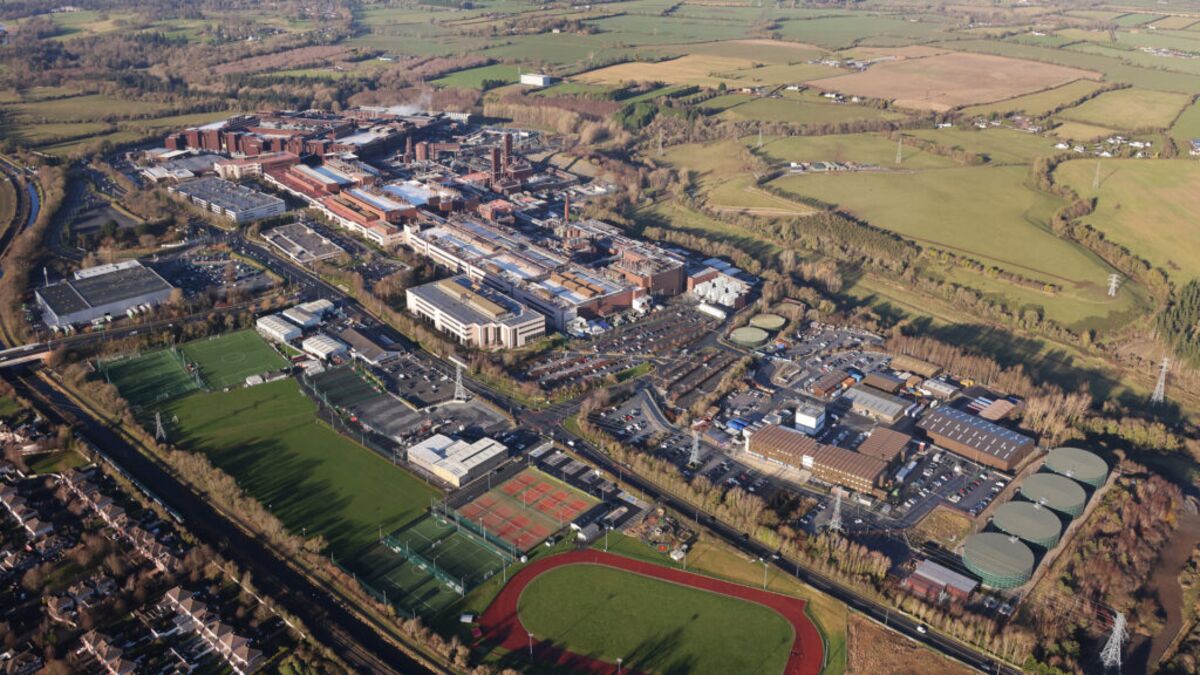
Intel will invest €5 billion ($5.7 billion) to expand its Leixlip, Ireland campus, targeting higher output of AI-era data center processors. The project scales capacity for products such as Xeon server processors and increases R&D activity. This capex signals renewed execution to regain manufacturing competitiveness in the AI chip race.
This reads more like a credibility signal than an immediate earnings catalyst: Intel is effectively telling the market it will keep funding its manufacturing reset even if near-term FCF stays pressured. That is supportive for the multiple only if investors believe incremental capex translates into share gains in server CPUs or future foundry wins; otherwise, the spend mechanically raises depreciation and extends the period before operating leverage shows up. In the next 1-3 months, the stock likely trades on whether management can tie this capex to concrete demand, not on the size of the outlay itself.
The more reliable beneficiaries are the semiconductor equipment and fab-adjacent names that get paid before Intel does: AMAT, LRCX, KLAC, and, at the ecosystem level, European industrial/build-out contractors and power infrastructure suppliers. The second-order loser is Intel’s capital-return profile; every euro redirected to capacity is a euro not available for buybacks or balance-sheet repair, which matters because the market is still treating INTC as an execution story with limited room for disappointment. If AI server demand migrates toward custom silicon and ASICs, Intel’s expanded process footprint could end up supporting lower-margin volume rather than the high-margin mix the bull case needs.
Contrarian view: the market may be overreacting to a spend announcement that does not by itself change competitive positioning against TSMC, AMD, or Nvidia. The real falsifier is not the capex number but whether Intel can show improving server share, gross margin stabilization, and credible foundry utilization over the next 2-4 quarters; absent that, the investment is just a larger depreciation load. Over 6-18 months, the key risk is that Intel becomes more levered to an AI cycle it is still trying to enter, while competitors monetize the demand first.
AI-powered research, real-time alerts, and portfolio analytics for institutional investors.
Overall Sentiment
mildly positive
Sentiment Score
0.25
Ticker Sentiment
