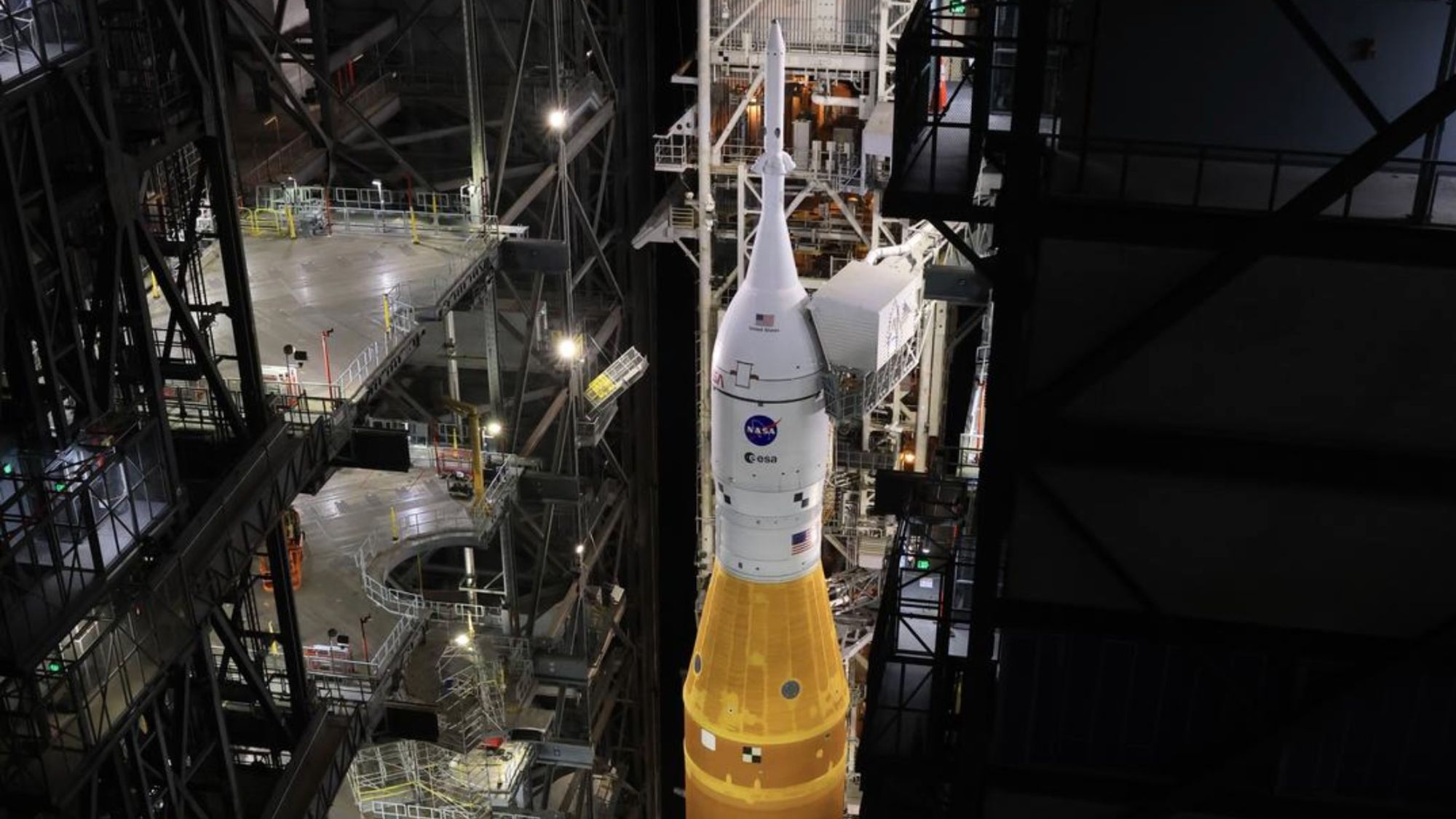
NASA rolled the Artemis 2 Space Launch System (SLS) stack off LC-39B and back into the Vehicle Assembly Building on Feb. 25 after a helium-flow malfunction was detected in the Interim Cryogenic Propulsion Stage following a wet dress rehearsal; the 4-mile rollback took roughly 10.5 hours. Engineers will access upper-stage helium tanks in High Bay 3 to diagnose and repair the issue, pushing the crewed mission’s earliest launch from an early-March window to no sooner than April 1 (additional opportunities Apr. 3–6) and likely requiring a subsequent wet dress rehearsal before flight clearance.
Market structure: Near-term winners are large defense/aerospace primes (Lockheed Martin LMT, Northrop Grumman NOC, RTX) that carry multi-year NASA/DoD backlog and can absorb a 4–8 week slip with minimal revenue recognition impact; near-term losers are small, launch-specific subcontractors and ground-support service providers whose next meaningful revenue was the March window. Competitive dynamics tilt subtly toward commercial launch providers (SpaceX privately) over time if SLS schedules slip repeatedly — every missed Artemis window increases commercial bid share for lunar/logistics work. Supply/demand: this is a localized demand shock (1–2 months) for heavy-launch ground crews and helium-handling services; expect short-dated implied volatility in aerospace equities and a modest bid for specialty helium and logistics spot markets.
Risk assessment: Tail risks include a multi-month rework cycle (Artemis‑1 like) causing >$100–300m incremental contractor remediation charges, congressional scrutiny and contract repricing, or a critical failure that stalls crewed programs for 6–12+ months. Time horizons: immediate (days) — volatility and guidance updates; short (4–12 weeks) — quarterly revenue blips for suppliers; long (1–3 years) — structural shift to commercial providers. Hidden dependencies: NASA schedule interacts with congressional funding cycles and supplier staffing constraints; a staffing shortage or parts bottleneck could amplify delays. Catalysts: successful/failed third wet dress rehearsal, NASA public schedule update (next 7–21 days), or a competing commercial lunar success.
Trade implications: Establish modest conviction trades sized to fund volatility: go long LMT and NOC (1–2% each) as defensive backlog plays, buy LMT 6–12 month 5–10% OTM call spreads if price dips >5% within 90 days. Implement a small tactical short on BA (0.5–1%) via May 2026 8–12% OTM put spread to hedge reputational/certification risk; use 30–60 day put spreads on small-cap launch suppliers with >30% revenue dependence on NASA to capture near-term downside. Options: sell short-dated call spreads on small-cap contractors to collect elevated IV; buy protection (long-dated puts) only if schedule slip >30 days.
AI-powered research, real-time alerts, and portfolio analytics for institutional investors.
Request TrialOverall Sentiment
mildly negative
Sentiment Score
-0.25
Contrarian angles: The market may underprice the resiliency of prime contractors — historic program delays (Apollo, Shuttle) depressed near-term stock moves but didn’t impair multi-year government revenue; consider adding to LMT/NOC on >8% pullbacks. Conversely, consensus may underweight upside to commercial launch contractors if NASA accelerates commercial awards after repeated SLS slips — a scenario that could re-rate commercial primes. Watch for an objective trigger: any announced slip beyond April 30 should materially increase short exposure to launch-specialist suppliers and rotate into larger defense primes within 48–72 hours.
