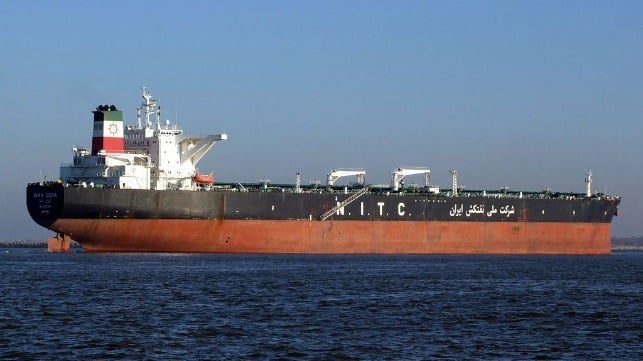
Iran has reportedly sold another 9 million barrels of crude from floating storage in the Gulf of Oman, worth roughly $900 million at current valuations. The U.S. is tightening enforcement with secondary sanctions threats against banks in China, Hong Kong, the UAE and Oman, signaling a broader crackdown on Iran’s oil sales network. The move raises geopolitical risk for oil flows and could have a meaningful impact on energy markets and regional financial intermediaries.
The immediate market implication is not just higher geopolitical risk premia, but a tighter spot-barrel clearing function for Atlantic Basin refiners. Prompt floating-storage barrels are disproportionately valuable because they bypass the normal lag between crude procurement and delivery, which means any successful interdiction of financing can first hit the cheapest, most fungible destination-sensitive buyers rather than outright global supply. That tends to widen medium sour differentials and support freight, insurance, and short-cycle refining margins before headline Brent fully re-prices.
The second-order winner is the sanctions-compliance stack: U.S.-linked banks, trade finance intermediaries, ship insurers, and maritime surveillance vendors should see structurally higher demand as counterparties de-risk exposure. The loser set is broader than Iranian barrels; Chinese teapot refiners, UAE/Oman logistics hubs, and smaller regional banks are likely to become the first choke points if secondary sanctions are enforced aggressively, which can create a sudden liquidity event in commodity prepayment channels. That kind of funding stress often shows up first in calendar spreads and tanker rates, not in outright crude immediately.
The key risk is timing. If the administration is using financial pressure as negotiation leverage, the policy could soften within weeks if talks progress, so the trade is best expressed with optionality rather than outright directional exposure. Conversely, if enforcement is real, the market may only be pricing the first-order loss of barrels and not the larger behavioral effect: buyers accelerate stockpiling while they still can, then abruptly step away from Iranian-linked flows, creating a temporary but sharp dislocation in prompt crude availability over the next 1-3 months.
Consensus is likely underestimating how non-linear secondary sanctions can be once a few banks are named. The base case is not that all Iranian exports vanish; it is that marginal buyers demand a much higher risk premium, which can compress realized prices for sanctioned sellers while lifting global benchmark volatility. That asymmetry favors long vol and relative-value energy expressions over naked long oil.
AI-powered research, real-time alerts, and portfolio analytics for institutional investors.
Request TrialOverall Sentiment
moderately negative
Sentiment Score
-0.35
