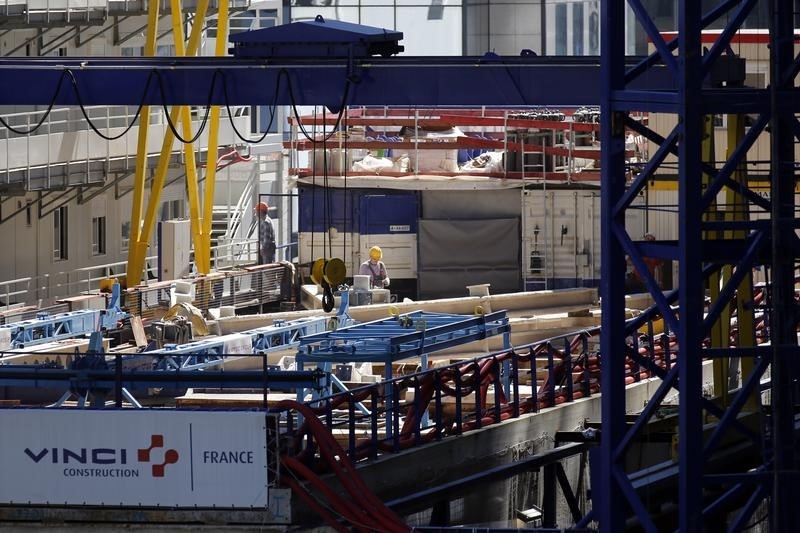
VINCI reported Q1 2026 revenue of 16.3 billion euros, roughly flat year on year, with 5% growth in Energy Solutions to 6.9 billion euros offsetting a more than 5% decline in Construction. Order intake rose 5% to 17.4 billion euros, lifting the order book to a record 74.9 billion euros, or about 15 months of activity. Management left full-year guidance unchanged despite ongoing Middle East geopolitical tensions and some route disruption at its airports.
The key second-order signal is not the flat top line; it is the mix shift toward electrification and digital infrastructure, which is a better leading indicator for capex intensity than headline construction volumes. If that demand persists, the beneficiaries are not just the obvious industrial contractors but also the electrical equipment, grid, data-center power, and mission-critical services chains that sit upstream and downstream of these projects. That should support relative strength in names exposed to power distribution and network buildout even if general European construction remains sluggish.
The order book expansion matters more than the quarter’s revenue print because it extends visibility into a period where macro noise can still obscure execution. A 15-month backlog gives management the option to preserve margin by being selective on project mix, which tends to favor larger, higher-specification work over commoditized civil contracts. Competitively, that can pressure smaller regional contractors that lack scale, procurement leverage, or access to long-cycle energy and digital projects.
Geopolitical disruption is the real catalyst path, but it is asymmetric by time horizon: days to weeks for route disruption and higher operating costs in aviation and logistics, months for rerouting and network normalization, and years only if the Middle East risk premium becomes embedded in travel demand assumptions. The market is likely underpricing the fact that even modest route changes can ripple into airport utilization, fuel hedging effectiveness, and maintenance scheduling rather than just passenger counts. The contrarian risk is that investors overreact to the headline tension while the actual earnings impact stays localized and temporary.
The broader read-through is that infrastructure tied to electrification is structurally better insulated than traditional construction, so valuation dispersion should widen. If investors continue treating all infrastructure as one bucket, they may miss the stronger medium-term earnings power in utility adjacency and digital capex beneficiaries versus cyclically exposed civil works. That favors a barbell approach rather than a broad industrial beta bet.
AI-powered research, real-time alerts, and portfolio analytics for institutional investors.
Request DemoOverall Sentiment
neutral
Sentiment Score
0.12
