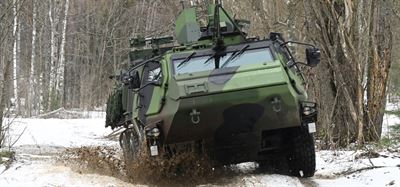
Patria has signed two procurement contracts with Germany under the CAVS programme worth over €2 billion (with a firm order portion exceeding €1 billion plus options) to supply up to 876 Patria 6x6 armoured vehicles in four variants, including NEMO turreted mortars and Kongsberg RS4 remote weapon systems. Deliveries start in 2026 with technology transfer to German partners (FFG, JWT, KNDS) to enable first locally built vehicles in 2027 and full local production to support Bundeswehr readiness by 2029; Patria says this is the largest single deal in its history, adding to prior orders of nearly 2,000 6x6 vehicles and >250 delivered. Ownership structure (State of Finland 50.1%, Kongsberg 49.9%) and the scale of the contract materially improve Patria’s revenue visibility and reinforce European defence industrial cooperation and security-of-supply dynamics.
Market structure: The German CAVS award (firm >€1bn, total >€2bn incl. options for up to 876 vehicles) concretely benefits Patria's ecosystem and its visible public equity conduit Kongsberg (KOG.OL) as supplier/part-owner, plus German primes and integrators (RHM.DE, selected Tier‑1s). Competes directly with non‑European 6x6 vendors (Oshkosh OSK, General Dynamics GD) for future European and NATO orders, shifting share toward European suppliers and lifting demand for steel, powertrains and defense electronics over 2026–2030. Macro cross‑asset: modest upward pressure on EUR (0.5–1% medium term) and German BUNDS (yields +5–15bp) from higher defense capex; commodity upside for specialty steel and copper 3–8% if programme scales beyond base order.
Risk assessment: Key tail risks: 15% chance of material production delay/overrun during 2026–2028 tech transfer, 10% political reversal/cancellation risk tied to German budget reprioritization before 2027. Hidden dependencies include German Tier‑1 capacity build-out, skilled labor and German export control alignment across CAVS nations; these create second‑order schedule risk into 2027 deliveries. Catalysts that can accelerate upside: Bundeswehr procurement funding confirmations (next 6–12 months) and visible local production milestones in 2027; negative catalysts include supply chain sanctions or a recession that trims defense budgets.
Trade implications: Direct: consider establishing a 2–3% long position in KOG.OL (target +20% in 12 months) and a 1–2% long in RHM.DE (target +15% in 12 months) to capture European defence re‑shoring. Relative/pair: long KOG.OL vs short OSK (size 1:1, small 1% portfolio exposure) to play European capture at the expense of US suppliers. Options: buy 12–18 month call spreads on KOG (25%/55% strikes) to limit premium and finance upside; sell modest covered calls after a 15% move. Rotate 1–3% away from cyclical commercial vehicle OEMs into European defense primes now; scale up after 1H2026 delivery confirmations.
Contrarian angles: Markets may underprice execution and margin compression from tech transfer — contracts often print headline values but deliver lower near‑term cash margins; assume 5–8% lower gross margins vs initial guidance until local factories stabilize (2027–2029). Historical parallel: Rheinmetall post‑2022 order surge saw strong share gains then mean reversion as margins normalized; expect similar pattern here, so size positions with stop‑losses (12–18%). Unintended consequence: faster European standardization could provoke reciprocal US trade/industrial policy responses, creating geopolitical procurement volatility; cap positions to avoid single‑event risk.
AI-powered research, real-time alerts, and portfolio analytics for institutional investors.
Request DemoOverall Sentiment
moderately positive
Sentiment Score
0.62
