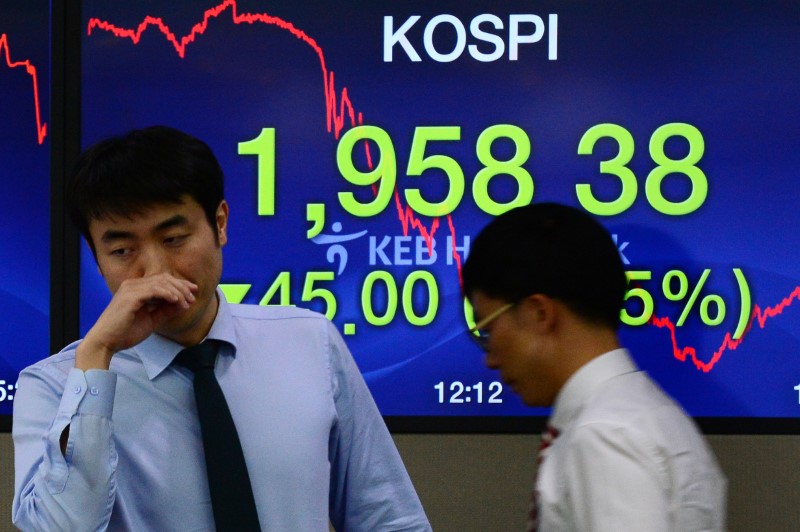
South Korea’s KOSPI was halted early Thursday after heavy losses in chipmakers triggered a sharp open drop of more than 6% to 7,769.16. Memory bellwethers sold off with Samsung down 7.3% and SK Hynix down nearly 9%, amid fears that AI optimizations could halve inference compute needs (reducing required AI processors) and that Meta may sell excess cloud capacity. Apple also drew attention for reportedly negotiating to buy memory chips from blacklisted Chinese producers amid cost pressure from high memory prices, while Nikkei reported Apple plans at least 5 new iPhone models through early 2027. Overall, the article links renewed downside to the market’s AI/chip optimism stalling after large gains (KOSPI up ~83% YTD).
This reads as a regime-check on AI scarcity pricing, not just a Korea selloff. If software and capacity optimization can lower inference demand, the market should stop extrapolating every AI spend line into linear memory/gpu unit growth; that is the real risk for Samsung and SK Hynix, whose valuations are most exposed to peak-cycle assumptions. The first-order reaction can extend for days, but the earnings revision risk is a 1-3 month issue as buyers push back on ASPs and inventory targets.
For Apple, cheaper memory sourcing is a modest input-cost tailwind, but the bigger implication is negotiating leverage across the component stack: once one flagship OEM shows willingness to multi-source from lower-cost producers, premium suppliers lose pricing power at the margin. That pressure can spill into Micron and the broader semi equipment complex if customers conclude AI-related demand is becoming more price-sensitive than previously modeled. The contrarian view is that this may be more about mix and timing than true demand destruction; if hyperscalers simply become more efficient, total compute consumption can still rise, but the near-term consequence is lower near-dated capex intensity and multiple compression for hardware names.
Falsifier: if upcoming Samsung/Hynix/Micron commentary still shows sequential price and bit-growth acceleration, and Meta/other hyperscaler capex guidance stays aggressive, this is likely a tradable de-rating rather than a structural AI top. Until then, the path of least resistance is lower for memory and Korean tech beta, with Apple only a relative beneficiary if sourcing negotiations actually translate into gross margin improvement.
AI-powered research, real-time alerts, and portfolio analytics for institutional investors.
Request DemoOverall Sentiment
moderately negative
Sentiment Score
-0.50
Ticker Sentiment
